Overview
Complete your degree, open new doors
Not everyone takes the same route into university, and that’s ok. Whether you’ve completed a HND and want to top-up to a full degree, or you’ve completed two years of Building Services Engineering elsewhere and are ready to finish your degree with us, then look no further. This course gives you the opportunity to complete your journey and achieve your goals.
In your top-up year, you’ll study third year modules from our Building Services Engineering BEng (Hons) degree, equipping you with the specialist knowledge and practical skills demanded in building services engineering.
Why study Building Services Engineering at LSBU?
- heart
- Heritage: we have been running courses for the Building Services Engineering industry since 1947.
- space-shuttle
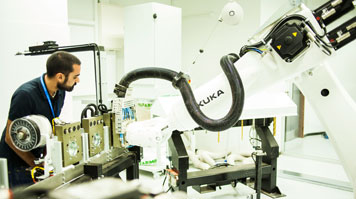
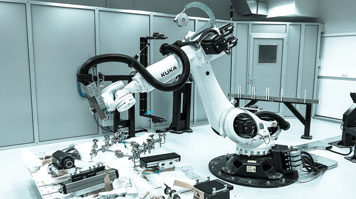
- We have one of the best laboratory–workshop complexes in London.
random- Study modes to suit you: study full-time or part-time one day a week.
- puzzle piece
- Employability: you'll have the option to undertake a work placement in your third year.
| ModeFul-time | Duration1 year | Start dateSeptember | Application codeK2J8 | Application method UCAS |
Watch our video to see how you can make yourself at home studying at LSBU.
Location
London South Bank University student union is located at 103 Borough Rd, London SE1 0AA.
If you are visiting our Southwark Campus, you may wish to use our downloadable campus map (PNG File 466 KB). For information on accessibility, see our DisabledGo access guides. See our location page for more details.
Entry Level Requirements
Need further information? Call us on 0800 923 8888 to discuss entry requirements.
Applicants seeking entry to the Level 6 Top-Up programme must meet the following criteria:
- Students with an HND (BSE) from LSBU will need an ALL pass at Level 5 to be accepted on this course.
- Possess a Higher National Diploma (HND) in a relevant subject, with at least 60 credits at merit level in Level 5 modules, or
- Hold an equivalent Higher Education qualification in a related discipline.
Additionally, applicants must demonstrate subject knowledge and academic ability equivalent to that of students who have successfully completed Levels 4 and 5 of the full-time BEng (Hons) Building Services Engineering programme. This includes foundational understanding in key areas such as thermofluids, electrical and mechanical building systems, engineering mathematics, and integrated design. At Level 6, all students are required to undertake an individual Design Project, which consolidates learning across the programme. Success in this module depends on the ability to apply prior knowledge in independent project work, technical analysis, and professional reporting.
Students must also choose one of two specialist pathways, each of which builds on relevant prior study:
- Electrical Route – focusing on advanced building electrical systems and power distribution
- Mechanical Route – focusing on heat transfer, thermal energy systems, and environmental control
Each of these specialist modules including assumes prior understanding of relevant Level 4 and 5 topics. Applicants should have completed core modules aligned with their selected pathway to ensure readiness for advanced study.
International Applicants
We welcome qualifications from around the world. International students must demonstrate English proficiency, typically through:
- IELTS score of 6.0 or above (with no component below 5.5)
- Cambridge English: Proficiency or Advanced – Grade C or above
Recognised prior learning (RPL)
Applicants may be able to use their learning or other life experiences to gain academic credit towards their course of study. Applicants need to demonstrate that their learning is equivalent to formal learning on the course and produce satisfactory evidence. If an applicant has gained a qualification from a professional body or another institution this may be credited towards the University qualification via our transfer credit scheme. The course leader will be consulted before approving the access.
Choose your country
Select country here:
Missing English and Maths qualifications?
If you do not have the required English and Maths qualifications needed to satisfy the entry requirements for this programme, we have courses available at our partner College that you can take to upskill in these areas. Find out more at South Bank College.
Advanced entry
If you have already completed some studies at another university, we may be able to consider you for advanced entry. Please see our advanced entry page for more information.
United Kingdom
£9790
Tuition fees for home students
International
£17400
Tuition fees for international students
Tuition fees are subject to annual inflationary increases. Find out more about tuition fees for Undergraduate or Postgraduate courses.
For more information, including how and when to pay, see our fees and funding section for undergraduate students.
Please check your fee status and whether you are considered a Home, EU or International student for fee-paying purposes and for our regulatory returns, by reading the UKCISA regulations.
See our Tuition Fees Regulations (PDF File 630 KB) and Refund Policy (PDF File 775 KB).
Possible fee changes
The University reserves the right to increase its fees in line with changes to legislation, regulation and any government guidance or decisions.
The fees for international students are reviewed annually and the University reserves the right to increase the tuition fees to reflect increased costs of delivery and to maintain an a high-quality student experience. This increase would be no more than Consumer Prices Index (CPI) increases plus 5%.
Scholarships
We offer several types of fee reduction through our scholarships and bursaries. Find the full list and other useful information on our scholarships page.
Are you an international student looking to kickstart your global career at LSBU? If so, our new LSBU Future Global Graduate Awards could help you benefit from the high-quality, career focused education that LSBU offers. Find out more about our Global Graduate Awards.
International students
The course is not currently open to international students.
International applicants can apply directly to LSBU and should consult our international how to apply guide for further information on the application process and key dates.
Course delivery modes and application methods
| Mode Ful-time | Duration 1 year | Start date September | Application code K2J8 | Application method UCAS |
Accommodation
Once we have made you an offer, you can apply for accommodation. You can rent from LSBU and you’ll deal directly with the university, not third party providers. That means we can guarantee you options to suit all budgets, with clear tenancy agreements and all-inclusive rents that include insurance for your personal belongings, internet access in each bedroom and on-site laundry facilities.
Or, if you’d rather rent privately, we can give you a list of landlords – just ask our Accommodation Service.
Read more about applying for accommodation at LSBU.
Finance
You don't need to wait for a confirmed place on a course to start applying for student finance. Read how to pay your fees as an undergraduate student.
Prepare to start
Applicant events
After you’ve received your offer we’ll send you emails about events we run to help you prepare for your course.
Enrolment
Before you start your course we’ll send you information on what you’ll need to do before you arrive and during your first few days on campus. You can read about the process on our Enrolment pages.
- Major project
This module is a culmination of the course, where the knowledge and skills gained are applied to a specific investigation, either design or research-based. You should be able to analyse the technical performance, environmental impact and economic feasibility of the project. The results should be in a form comparable to industrial standards, based on current guidelines or regulations. Assessment method: 100% coursework. - Passive building design
On completing this module, you'll be able to analyse a building and its world-wide location, and propose novel and effective passive methods to reduce energy consumption and improve occupant comfort. You'll understand the requirements of the wider design team and adapt and communicate your proposals appropriately. Assessment method: 100% coursework. - Energy management and controls
This module examines the controls and processes that are necessary for efficient and effective operation of buildings and their engineering services. It provides an understanding of control elements and building energy management systems, and the way that information from these systems can be used to manage energy. The module also presents tools for financial analysis and reporting. Assessment methods: 60% coursework, 40% exam.
Plus two modules from either the electrical or mechanical route:
Electrical route
- Lighting and electrical systems
The module is designed to equip you with up-to-date knowledge and skills to enable you to work in the design, installation, operation and maintenance of lighting and electrical systems in building services industries. Lighting will be covered as far as required to undertake design calculations and appreciate what is assumed in the use of proprietary design software packages. Assessment methods: 30% coursework, 70% exam. - Electrical power systems and distribution
This module focuses on 11kV high voltage electrical power system and Low-Voltage Distribution and equipment, focussing on their application on electrical building services. Assessment methods: 30% coursework, 70% exam.
Mechanical route
- Heat and mass transfer applications
This module provides an advanced study of heat and mass transfer, the design of heat transfer equipment, the application of heat transfer within a building envelope and the development of the CIBSE Admittance Method used for the assessment of cooling and heating loads. It also deals with the calculation of cooling loads using commercial software, and the strategies for the reduction of energy used for cooling including thermal mass, natural ventilation, night time cooling, evaporative cooling. Assessment methods: 50% coursework, 50% exam. - Thermal energy systems
In relation to sustainable engineering, you'll develop a deep understanding of the principles that govern building services thermal energy systems and renewable and Low or Zero Carbon technologies. Assessment methods: 50% coursework, 50% exam.
| Year 1 | Year 2 | Year 3 | |||
|---|---|---|---|---|---|
| SEMESTER 1 | SEMESTER 2 | SEMESTER 1 | SEMESTER 2 | SEMESTER 1 | SEMESTER 2 |
| Engineering Mathematics &. Modelling | Advanced Math. & Modelling | Energy Control & Mang. | Innovation & Enterprise | Major Project | |
| Engineering Principles |
Design Applications 5 AND Project Management | Design Analysis | |||
| Design and Practice | Electrical Installation Distribution and Lighting | Option | Energy Resources | ||
| Mechanical Services for Buildings | Thermo-fluids, Air Conditioning & Refrigeration | Options | |||
Careers
Employability Service
At LSBU, we want to set you up for a successful career. During your studies – and for two years after you graduate – you’ll have access to our Employability Service, which includes:
- Free employability workshop and events for student all year round, more details can be found on our event section.
- Online board where you can see a wide range of placements: part-time, full-time or voluntary. You can also drop in to see our Job Shop advisers, who are always available to help you take the next step in your search.
- LSBU Careers Hub offering group workshops on CVs, interview techniques and support, guidance on future careers, as well as loads of career resources, connecting you with employers, exciting events, 1-1 support and relevant workshops.
Our Student Enterprise team can also help you start your own business and develop valuable entrepreneurial skills.
Building service engineers help buildings to deliver on their potential. They work with architects and construction engineers to produce buildings that offer the functionality and comfort we expect, with the minimum impact on our environment. They design the lighting appropriate for the space, the heating, cooling, ventilation and all systems that ensure comfort, health and safety in all types of buildings, residential, commercial and industrial.
Take a look at some potential careers, including building services engineer, on Prospects.
This course will prepare you for a career in the building services engineering industry in areas such as: design and build, contracting, consultancy, energy management, and facilities management.
BEng degrees include additional science and maths; many recruiters look favourably on BEng graduates for this reason. If you combine your BEng (Hons) Building Services Engineering with an accredited Masters, you can achieve Chartered Engineer status.
It became clear to me that industry ties with LSBU are strong. I graduated with a first class Honours degree and promotion to a permanent engineering post at work - so it was certainly worthwhile.
Cara Hobbs, Alumna, BEng Building Services Engineering
We have been running courses for the building services engineering industry since 1947 and in that time we’ve built up a lot of industry contacts. Our close links with industry ensure that our course is up-to-date with their needs – and this means our graduates are in demand.
Put your skills to work
The placement gives you the opportunity to spend a year in the work-place, honing your transferable skills and proving your academic learning in the development of real-world systems. During the year you’ll stay in regular contact with your tutor and your peers – and we’ll make sure that you have the support you need.
Teaching and Assessment
Value of a BEng programme
As a BEng programme, this course provides you with the environment and guidance to acquire a deeper understanding of the essential facts, concepts, theories and principles of mechanical engineering and its underpinning science and mathematics. These core mathematic, scientific and management skills are needed to meet the requirements of Chartered Engineer status. Many recruiters will look favourably on BEng graduates for this reason.
| Lectures, seminars and workshops | Self-directed study | |
|---|---|---|
| Year 1 | 30% | 70% |
| Year 2 | 31% | 69% |
| Year 3 | 22% | 78% |
Personal Tutoring
As a Built Environment and Architecture student, you will be allocated a named tutor during your first three weeks at LSBU. The role of your tutor is to be your primary contact for academic support. Your personal tutor will be the same person throughout your course.
Your tutor will support you to get the most of your time at LSBU, providing advice and signposting to other sources of support in the University.
Your tutor should be the first person at the university that you speak to if you are having any difficulties that are affecting your work. These could be academic, financial, health-related or another type of problem.
You will have meetings with your personal tutor periodically. One-on-one meetings can be arranged on request. You can contact your tutor for additional support by email or in person.
Register your interest
Gecko content requires marketing cookies
This content is provided by a third party. To view it, please enable marketing cookies. This may involve the processing of personal data.