

Book an Open DayGet info and updates

icon_cup_red.svg

Our Architecture graduates are among the top 2 for highest graduate salaries for this subject area in the UK (LEO Data, 2025)

icon_rocket_red.svg

We’ve been offering architectural education for over 100 years, with roots in London Council School of Building (1904) and Brixton School of Building (1940)

icon_people_red.svg

This course is validated by the Royal Institute of British Architects (RIBA), providing the first of three steps towards becoming a qualified architect.

Overview

Complete your degree. Open new doors in Architecture.

Not everyone takes the same route into university, and that’s ok. Whether you’ve completed a HND and want to top-up to a full degree, or you’ve completed two years of Architecture elsewhere and are ready to finish your degree with us, then look no further. This course gives you the opportunity to complete your journey and achieve your goals.

In your Architecture top-up year, you’ll join the final stage of our undergraduate programme, studying third-year modules that align with Royal Institute of British Architects Part 1 criteria. This year is designed to consolidate your existing knowledge while advancing your design thinking, technical expertise and professional awareness, preparing you for progression into practice or further study.

Through a sequence of design studio modules, you’ll develop your ability to analyse complex urban contexts, define project briefs and deliver detailed architectural proposals that respond to social, cultural and environmental factors. Alongside this, you’ll explore the theoretical foundations of architecture, apply integrated technical and environmental design principles, and gain an understanding of professional practice within the construction industry.

This programme encourages you to think beyond technical skills and develop the mindset of an architect - looking beyond buildings as objects to understand how people experience spaces in everyday life.

With a curriculum built around community-first design, you’ll explore themes such as materials and craft, reuse and repair, public space and belonging, thresholds and neighbourhoods, climate and comfort, movement and making. Through live local projects, discussion and hands-on studio work, you’ll learn how architecture can respond meaningfully to real social contexts.

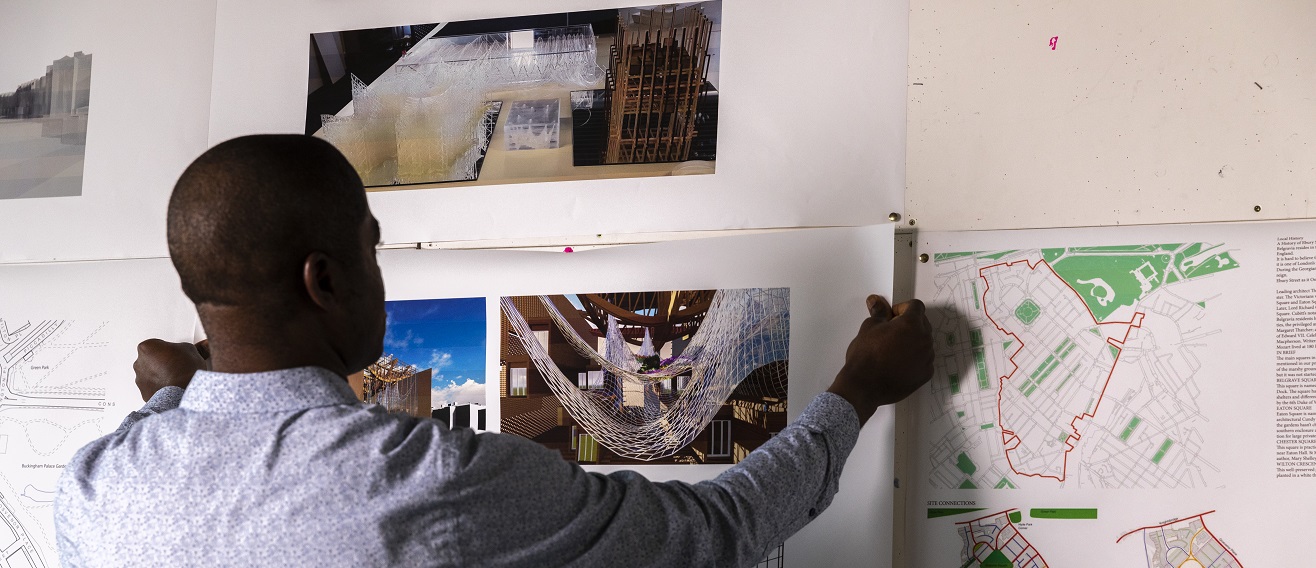
This is a hands-on, creative and rewarding degree. You’ll learn by doing - developing ideas through drawing, sketching, modelling and making; and use digital and physical tools to test and refine your designs. Alongside studio work, you’ll explore how architecture has developed over time, learn how buildings are constructed, and design with sustainability in mind.

At LSBU, London is your classroom. Studying in Central London puts you at the heart of one of the world’s most inspiring built environments. From our dedicated studio spaces on the 6th, 7th and 8th floors, you’ll look out across London’s skyline, where iconic landmarks offer daily inspiration.

You’ll explore the city through site and building visits, walking studies and fieldwork. Your immediate neighbourhood of Elephant and Castle plays a central role in studio teaching. As a major area of regeneration, it offers a living laboratory where you can directly engage with questions of community, public space, reuse, repair and belonging. Studio projects are shaped by real places and real partners, bringing social purpose into the design process.

You’ll be taught by research active, industry-experienced academics with extensive professional knowledge and networks. Our staff have received global acclaim for groundbreaking research, and contributed to major projects such as the extension of the Leicester City football stadium. We’ve also exhibited at Venice Biennale, and advanced the conversation on women in architecture around the world.

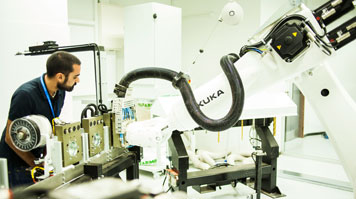
To prepare you for professional practice, you’ll work in industry-ready facilities. You’ll have access to dedicated studio spaces that foster a culture of sketching, model making, discussion and critique, alongside facilities that encourage experimentation and precision. Facilities include timber and metal workshops, rapid prototyping, laser cutting, 3D printing, robotic fabrication, digital visualisation and scanning, an animation studio and a virtual reality headset.

Past students have won awards for their ideas and contributions towards on-going social initiatives. Browse the 2025 Architecture End of Year Show catalogue to see how they have taken their ideas into the world.

Meet Pele, Architecture student

Is this course right for me? 

If you’re a community-focused and collaborative person, then this is the course for you. If you’re academically curious and technically minded, with a creative flair, then this is the course for you. If you’re ready to learn hands-on and take on new challenges, then this is the course for you. No matter your personality, background, or way of thinking, whether you’re introverted or extroverted, neurotypical or neurodiverse, there’s a place for you in Architecture at LSBU.

Above all though, if you’re hungry to create your own version of success then LSBU is right for you. Because the making of you doesn’t begin and end with just your degree, everything that’s brought you here today is part of your story; your experiences, the life you’ve lived, the skills you’ve gained and the goals you’re chasing.

Not only do we see this, but we value that in you. We’re not in the business of forcing you into moulds, instead we’re here to help you break them. If you’re ready to embark on a journey of hard work, fulfilment and self-discovery, then Architecture at LSBU is definitely right for you.

Course Content

What will I learn? 

What makes LSBU unique is how everything connects. Your design projects link directly with technology and communication modules, while history and theory help you understand the ideas behind your work. This joined-up approach means each part of the course supports the others, helping you develop as a confident and well-rounded designer.

During your top-up course, you’ll apply your architecture skills and knowledge to wider social and urban contexts. You’ll take on detailed and ambitious studio projects, spending more time developing resolved design proposals. These projects are closely linked to technology, structures and professional practice, helping you bring together your creative ideas and technical knowledge at a higher level.

You will engage with more complex design studio projects, with more time to resolve detailed design solutions, linked to technology and structures.

As the first of the Third Year design modules, this module is designed to introduce you to the ambition and scope of Third Year design, set the philosophical and systemic context for the year’s design investigations, and reinforce the importance of group work and peer learning.  
It consists of group analysis, group and individual design and focuses on observing, interpreting and positively influencing complex urban relationships. Assessment method: 100% coursework.

This module is based in the design studio and generates a detailed analysis of physical, cultural, social and economic context. It develops an understanding of the spatial organisation and form of buildings. You will be asked to investigate an area of the city, from which you will develop a client brief. You will then select one of the sites proposed by the studio tutors, and develop a design for the site, responding to both the context and to the building programme. The module enables you to become aware of design approaches, ideas and methodologies for the final design project in Design 303. Assessment method: 100% coursework. 

This module concerns the theoretical underpinnings of architecture and philosophical aspects of its interpretation by exploring the meaning, interpretation, history and relevance of ideas in architecture. You will be asked to analyse and investigate a specific site and to develop an architectural position, which will be used to inform a
given framework brief. The aim is to utilise the design of a building and its physical context to interrogate, test, illustrate and explain an understanding of a specific urban context and its  
relationship with an architectural proposal. Assessment method: 100% coursework. 

The module completes the study of construction technology, environmental design and their application in building design to the level defined in the criteria for RIBA Part 1 and linked to the Design 303 project.

This module fulfils the requirements for knowledge of the wider role and duties of the architect in relation to society and the construction industry as set out in the RIBA Part 1 criteria. Assessment method: 100% coursework. 
* Modules are subject to review and change throughout the year.

Where will I learn?

Explore life at LSBU from anywhere - Take a virtual tour to explore our campus, discover key facilities and experience what student life is like.

Teaching and Assessment

How will I learn?

This is a hands-on and creative course, with design projects making up more than half of your assessed work. Most learning takes place in the design studio, where you’ll develop ideas through drawing, making, discussion and testing, supported by tutors throughout the process. You’ll learn through live projects, site and building visits, field trips, workshops, lectures and one-to-one tutorials, with regular studio crits and pin-ups helping you share work, receive feedback and build confidence.

Many projects are shaped by real places and local partners, so your work connects directly to the world around you. We have previously worked with organisations such as Ministry of Sound and are currently collaborating with BABS Community Garden at the Clarence Centre Courtyard. You’ll also work across year groups and take part in community-first design challenges, joining one of six themed design studios in Years 2 and 3. Learning alongside apprentices brings practice-based insight into studio discussions and helps bridge the gap between study and professional practice.

You’ll develop your ideas using industry-standard facilities, including dedicated studio spaces and making workshops. You’ll work at different scales - from hand sketches and physical models to digital prototypes. Equipment use is included as part of your course; materials are paid for by students. Together, this approach helps you build confidence, creativity and practical skills for contemporary architectural practice.

Careers

What's in it for me?

Going to university might just be the biggest investment you ever make, but with us by your side you can turn a degree into a bright future, full of purpose, passion and a career you can be proud of, which may be why our graduates consistently earn the highest average salaries across London Modern universities (LEO Data, 2024, 2025, 2026).

With Architecture at LSBU you get:

  • Professional accreditation and full validation by the Royal Institute of British Architects and the Architects Registration Board
  • Access to a range of exciting events that help grow your professional network and architectural experience
  • Trained in industry-standard facilities that get you ready for the world of work and replicate a real architectural firm
  • To work on community projects through our connections with organisations such as Southwark Council, English Heritage and We Are Waterloo
  • The chance to undertake placements and apprenticeships, past students have trained with firms like RSHP, Grimshaw Architects and Scene Architects
  • A supportive and inspiring environment – 100% of students say that teachers supported their learning well (Discover Uni)

Flexibility in career paths — some students go on to complete all three parts of their RIBA training, while others take their degree into creative fields such as interior design, fashion, or urban planning. None of these paths is less valid than the other; we nurture all ambitions and help you shape the career that’s right for you.

An end-of-year show where students showcase their skills to industry contacts at local, national, and international levels, giving you the chance to present your work to a professional audience and make meaningful connections. Browse the work from the 2025 show on Dezeen .

We actively build strong professional links by involving practitioners in teaching and studio sessions, and hosting lectures with guest speakers ranging from emerging architects to internationally recognised design researchers. These links help you gain the skills that employers really want.

Guest lecturers from the past have included:

  • Prof Iain Borden, Professor of Architecture and Urban Culture at University College London
  • Dr Andrew Wilson, Senior Lecturer in Architecture at University of Queensland
  • Sophie McCarthy, Design Director at Atomik Architecture
  • Ian Bogle, Creative Director at Bogle Architects
  • Stephen Hadley, Associate Director at Stanton Williams
  • Kevin Coello, Architecture Assistant at Stanton Williams

Accreditation

Our courses are validated by the Royal Institute of British Architects (RIBA), and prescribed by the Architects Registration Board for RIBA part 1, RIBA part 2 and RIBA part 3.

The Royal Institute of British Architects (RIBA) is the professional members' organisation for architects that champions better buildings, communities, and the environment through architecture. They’ll provide you with guidance on professional standards, training, support, and recognition, helping you rise to the peak of your professional on a global scale.

LSBU CareerSmart is your ultimate gateway to career success. Our innovative programme is designed to ensure you graduate with more than just a degree, providing the support you need to stand out in a competitive job market. We've got all the tools you need, including:

  • AI Powered Career Sets - Get instant personalised feedback on your CV and cover letter by submitting it via our AI powered career tool.
  • Gamification Interviews - Get ready to pass those interviews with unlimited training access to our gamification interviews and psychometric tests!
  • Personalised Career Development Dashboard - Keep up with your skills progression with free access to practical assessments, LinkedIn learning, mentoring, and industry-standard facilities.

We understand that you’re in the driver’s seat of your career, which is why we’re committed to matching your passion and energy every step of the way.

Find out more

Entry Level Requirements

    To be considered for entry to the BA (Hons) Architecture Top-Up course, applicants must have successfully completed a relevant Level 5 qualification in architecture or a closely related discipline. This may include:

    • A Foundation Degree in Architecture or Architectural Design (or equivalent);
    • A Higher National Diploma (HND) in a subject aligned with architectural practice;
    • An international equivalent that demonstrates comparable academic achievement and design training.

    Applicants must be able to demonstrate:

    • A strong academic background in architectural education, including studio-based design work;
    • Design skills in both digital and physical media, including the ability to think and work in three dimensions;
    • A portfolio of work that reflects the academic level, design quality, and creative development expected at the end of Level 5;
    • Proficiency in English language: for international applicants, an IELTS score of 6.0 (with no component below 5.5), or equivalent.

    Applicants are required to present a portfolio. The quality and rigour of the portfolio will be a key factor in determining suitability for the Top-Up year.

Choose your country

  • Afghanistan
  • Albania
  • Algeria
  • Angola
  • Argentina
  • Australia
  • Austria
  • Azerbaijan
  • Bahrain
  • Bangladesh
  • Barbados
  • Belgium
  • Botswana
  • Brazil
  • British Council Women in STEM Scholarships
  • Bulgaria
  • Cambodia
  • Cameroon
  • Canada
  • Chile
  • China
  • Colombia
  • Croatia
  • Cyprus
  • Czech Republic
  • Denmark
  • Dominican Republic
  • Egypt
  • Estonia
  • Ethiopia
  • Finland
  • France
  • Gambia
  • Georgia
  • Germany
  • Ghana
  • Greece
  • Hungary
  • India
  • Indonesia
  • Iran
  • Iraq
  • Ireland
  • Italy
  • Jamaica
  • Japan
  • Jordan
  • Kazakhstan
  • Kenya
  • Kuwait
  • Latvia
  • Lebanon
  • Libya
  • Lithuania
  • Luxembourg
  • Malaysia
  • Malta
  • Mauritius
  • Mexico
  • Mongolia
  • Morocco
  • Myanmar
  • Nepal
  • Netherlands
  • New Zealand
  • Nigeria
  • Norway
  • Oman
  • Pakistan
  • Poland
  • Portugal
  • Qatar
  • Romania
  • Russian Federation
  • Saudi Arabia
  • Senegal
  • Serbia
  • Sierra Leone
  • Singapore
  • Slovakia
  • Slovenia
  • Somalia
  • South Africa
  • South Korea
  • Spain
  • Sri Lanka
  • Sweden
  • Switzerland
  • Thailand
  • Trinidad and Tobago
  • Tunisia
  • Turkiye
  • Uganda
  • Ukraine
  • United Arab Emirates
  • United States of America
  • Uzbekistan
  • Venezuela
  • Vietnam
  • Zambia
  • Zimbabwe

Need further information?

Call us on 0800 923 8888 to discuss entry requirements.

More contact info

Apply

Course delivery modes and application methods

Mode Duration Start date Application code Application method
Full-time 1 year September K101 UCAS

International (non Home) applicants should follow our international how to apply guide.

How to apply

International students

International applicants can apply directly to LSBU and should consult our international how to apply guide for further information on the application process and key dates.

Accommodation

Prepare to start

Applicant events
After you’ve received your offer we’ll send you emails about events we run to help you prepare for your course. You’ll also be invited to our Applicant Taster Day so keep your eyes peeled!
Enrolment
Before you start your course, we’ll send you information on what you’ll need to do before you arrive and during your first few days on campus. You can read about the process on our enrolment pages.

Fees

United Kingdom

£9790

Tuition fees for home students

International

£17400

Tuition fees for international students

Tuition fees are subject to annual inflationary increases. Find out more about tuition fees for Undergraduate or Postgraduate courses.

For more information, including how and when to pay, see our fees and funding section for undergraduate students.

Please check your fee status and whether you are considered a Home, EU or International student for fee-paying purposes and for our regulatory returns, by checking at the the UK Council for International Student Affairs (UKCISA) find your fee status page.

Visit our Policies and procedures page for details on fees policies.

Possible fee changes

The University reserves the right to increase its fees in line with changes to legislation, regulation and any government guidance or decisions.

The fees for international students are reviewed annually and the University reserves the right to increase the tuition fees to reflect increased costs of delivery and to maintain an a high-quality student experience. This increase would be no more than Consumer Prices Index (CPI) increases plus 5%.

Scholarships

We offer several types of fee reduction through our scholarships and bursaries. Find the full list and other useful information on our scholarships page.

Contact information

International team enquiry

Register your interest