


In the rapidly changing world around us, it's imperative that you're able to think dynamically to create advantage in your life. This module encourages you to question what you see and experience around you and in your prospective engineering field with an aim to enhance your creativity to discover new and better ways of doing things. It aims to equip you with methods and processes to recognise opportunities and to plan on harnessing commercially viable benefits that may exist from exploiting those opportunities in a sustainable fashion. This might be a product or service (such as consultancy or contract management). The application of project management principles will help to define the critical path of a proposed business and how the many processes involved (planning, market research, market placement, finance, operations, human resources etc.) are interlinked throughout the initial planning exercise and how they can change over time. You'll be expected to reflect on what you can contribute towards a group. Assessment method: 100% coursework.
This module will develop your professional skills and portfolio in preparation for a career as a Design Engineer. You'll apply knowledge and understanding of a range of engineering design principles and techniques, using appropriate theoretical and practical methods to the analysis and solution of engineering design problems, exploring design alternatives and understanding the implications of trade-offs in the design process. You'll learn how to prototype and implement your proposed solutions using appropriate digital manufacturing technologies. In addition to this, there will be significant content relating to management of the design process, presentation of ideas, and working in teams. Assessment method: 100% group project.
This module introduces the core concepts of manufacturing systems and computer integrated manufacturing in the contemporary product realisation process. This module will develop your understanding of (and ability to use) commercial CAD/CAM/CAE tools and processes in engineering design projects. And your awareness of quality issues and their application to continuous improvement, including inspection technologies and methods. Covering: manufacturing and operations strategies, manufacturing automation,manufacturing process planning, quality control and inspection, material handling control and retrieval, robotics applications in manufacturing and operations management. Assessment: 100% coursework, made up of two elements: Element 1: 30% This is based the lecture series and will take the form of a set problem relating to that content. Element 2: 70% Practical application and use of the skills developed in mould tool design and CAD/CAM through a design project.
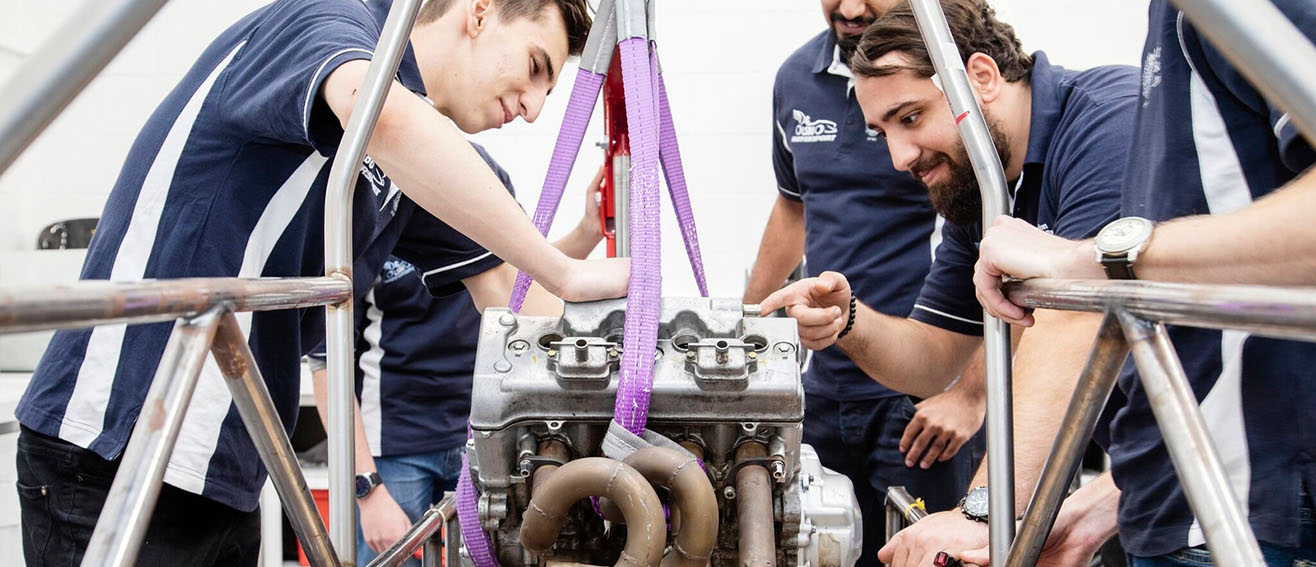
This module provides an opportunity to study heat transfer, fluid mechanics and thermodynamics exploring in-depth internal combustion engines, fluid-mechanics governing equations, performance of various types of pumps and turbines, and application of heat transfer to extended surfaces and heat exchangers. Covering: Internal combustion engine – comparison between air-standard cycle and real indicated cycle, performance characteristics, gas exchange process, combustion systems; Navier Stokes equations, and their application to fundamentalfluid mechanics problems; Rotodynamic machines – comparison to positive displacement machines, output characteristics matching to demand characteristics, practical examples of pumps/fans/turbines; Rotodynamic machines – Eulers equation, inlet and outlet velocity diagrams, application to Pelton wheel; Heat transfer – Extended surfaces (fins), Ficks Law, Heat Ex, condensers and evaporators. Assessment: a two-hour examination (70%) and a Workshop log book and a formal report assignment (30%).
The individual major project requires students to plan, execute, review and report upon a major piece of technical work directly related to your degree discipline. It provides you with the opportunity to develop a high degree of subject specific expertise. This module differentiates from others on the course taken due to the high degree of autonomous study expected. This flexibility should be seen as an opportunity to explore new areas of interest and to acquire new and often unexpected skills. Assessment: 1.Project Arrangement form (no mark but compulsory submission); 2.Project Progression Report (5%); 3.Interim report (10%) 4.Final project report Comprising: i.Technical quality (literature review and understanding of the necessary background, results & outcomes, analysis, evaluation of the findings, quality of abstract and conclusions) 45% ii.Quality of referencing 5% iii.Report presentation (structure and organisation, standard of English, quality of diagrams and graphs) 10% iv. Evidence and quality of project planning and management 5% v. logbook 10%; 5. Project oral presentation and demonstration with questions 10%.