



Book an Open DayRegister your interest

icon_cup_red.svg

Approved by JBM the Joint Board of Moderators as fully satisfying the educational base for an Engineering Technician.

icon_rocket_red.svg

Academic progression: Progress to degree level via a part-time route.

icon_people_red.svg

Industry relevant: Our Industry Advisory Panel advises on course content.

Overview

As part of our ongoing commitment to keeping our courses up to date and aligned with current industry standards, this programme has been updated from a Higher National Certificate (HNC) to a Certificate of Higher Education (CertHE) for students starting from September 2026.

If you are currently enrolled on the HNC programme, this change will not affect your studies, and you will still receive an HNC qualification upon successful completion of the course.

The engineers that made the world

From the rebuilding of inner cities to remarkable constructions like the Channel tunnel, the world is full of building and infrastructure projects that couldn’t happen without civil engineers. This course has been developed with input from our Industrial Advisory Panel to give a practical design-orientated course which will equip you with the skills and qualifications you need to join the construction industry.

If you intend to do a part-time degree at LSBU, we advise taking the CertHE route, as it is closely integrated into our degree programmes. Year 2 of the CertHE is also designed for graduates from other fields, now working in civil engineering.

The Shard London

Course Content

What will I learn? 

This Higher National Certificate course explores the fundamentals of civil engineering, leaving you well prepared for advanced entry (subject to CertHE grades) at level 5 on to the degree programme on a full-time basis, or part-time basis, or apprenticeship basis. It covers the mandatory JBM civil engineering threads for approval of the course on behalf of the Engineering Council allowing the cited progression at level 5 of the degree programme.

This module will introduce you to the properties and applications of a variety of engineering materials, including some innovative materials. In addition, it will introduce you to engineering geology and geomaterials (rock and soils). Whilst traditional lectures and laboratories will be used as a means of delivering the course content, there will also be emphasis on the teaching in the field through site visits. Assessment methods: 50% coursework, 50% exam. 

This module aims to provide you with the knowledge of the interrelationships between industry, professional bodies and education, and an understanding of key professional and research requirements. It will provide you with a roadmap for your professional career, and will enable you to prepare for employment in the construction discipline. Assessment method: 100% coursework. 

This module consolidates the mathematical skills that underpin the Civil Engineering degrees. It's specifically designed to cater for the wide differences in mathematical background of students to reach an equivalent A-level maths and then extending it by introducing the main mathematical techniques that are required in the early stages of Civil engineering degrees. The module is delivered over two semesters. Assessment methods: 50% coursework, 50% exam. 

This module will teach you the fundamentals of structural mechanics and strength of material, and you'll use numerous worked examples to complement your understanding. You'll be introduced to a computer aided analysis package. You'll reinforce your understanding of structural concepts by studying some well known historical failures. Finally, you'll develop introductory principles of structural engineering design though open-ended exercises and case studies. Assessment methods: 50% coursework, 50% exam. 

 This module will introduce you to the basic theory and practice of land surveying, particularly as it applies to civil engineering. You'll learn or revise the main concepts of three-dimensional geometry and relate them to practical surveying exercises. You'll be taught to use various pieces of surveying equipment, including tape, level, theodolite and total station. You'll learn how measurements are taken and booked, and how to carry out various relevant computations, including the assessment of error and the calculation of reduced level, coordinates and bearings. You'll use the knowledge you've acquired to carry out a field project. This project will involve tape and offset survey, levelling, traversing and calculation of volume. In addition you'll learn to carry out simple setting out procedures, including the analysis and setting out of curves, and you'll be introduced to the concepts of GPS and its associated technology. You'll learn the associated surveying calculations, adjustment and analysis of survey observations. Finally, you'll gain an appreciation of the need for a quality management process/system in undertaking practical work. Assessment methods: 50% coursework, 50% exam.

This module consolidates the mathematical skills that underpin the Civil Engineering degrees. It's specifically designed to cater for the wide differences in mathematical background of students to reach an equivalent A-level maths and then extending it by introducing the main mathematical techniques that are required in the early stages of Civil engineering degrees. The module is delivered over two semesters. Assessment methods: 50% coursework, 50% exam. 

* Modules are subject to review and change throughout the year.

Explore life at LSBU from anywhere - Take a virtual tour to explore our campus, discover key facilities and experience what student life is like.

Explore our campuses

Facilities

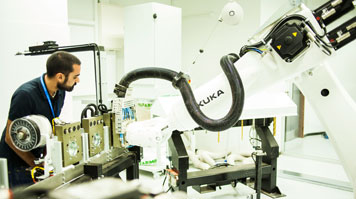
Civil Engineering students have full use of our Strength of Materials laboratory during your studies with us.

This state-of-the-art facility is capable of performing  product qualification testing and aiding knowledge development for structural assemblies and structural and mechanical components.

Teaching and Assessment

How will I learn?

Personal Tutoring

As a Built Environment and Architecture student, you will be allocated a named tutor during your first three weeks at LSBU.  The role of your tutor is to be your primary contact for academic support. Your personal tutor will be the same person throughout your course.

Your tutor will support you to get the most of your time at LSBU, providing advice and signposting to other sources of support in the University.

Your tutor should be the first person at the university that you speak to if you are having any difficulties that are affecting your work. These could be academic, financial, health-related or another type of problem.

You will have meetings with your personal tutor periodically.  One-on-one meetings can be arranged on request.  You can contact your tutor for additional support by email or in person.

Careers

What’s in it for me?

Employability Service

At LSBU, we want to set you up for a successful career. During your studies – and for two years after you graduate – you’ll have access to our Employability Service, which includes:

  • Free employability workshop and events for student all year round, more details can be found on our event section.
  • Online board where you can see a wide range of placements: part-time, full-time or voluntary. You can also drop in to see our Job Shop advisers, who are always available to help you take the next step in your search.
  • LSBU Careers Hub offering group workshops on CVs, interview techniques and support, guidance on future careers, as well as loads of career resources, connecting you with employers, exciting events, 1-1 support and relevant workshops.

Our Student Enterprise team can also help you start your own business and develop valuable entrepreneurial skills.

You'll  develop a wide range of employability skills through our vocational approach to teaching and a focus on a range of technical knowledge and skills.

Graduate success stories

Recent students from this course have gone onto jobs such as: Project Manager, Quantity Surveyor, Senior Structural Technician, Civil Engineer and Network Maintenance Manager.

Continuing to degree level qualifications

If you complete this course, you will be able to apply for further study at undergraduate level.

If you excel at CertHE level, you may be offered advanced entry to the Honours degree programme, subject to meeting minimum professional experience levels.

Accreditation

This qualification is approved by the Joint Board of Moderators (JBM) comprising the Institution of Civil Engineers,  Institution of Structural Engineers, Institute of Highway Engineers, and the Chartered Institution of Highways and Transportation on behalf of the Engineering Council as fully satisfying the educational base for an Engineering Technician (EngTech).

See the JBM website for further information.

Institute of Civil Engineers Logo
The Institution of Civil Engineers is a qualifying body, a centre for the exchange of specialist knowledge, and a provider of resources to encourage innovation and excellence in the profession.
Chartered Institute of Highways and Transportation logo
The Chartered Institution of Highways and Transportation is concerned specifically with planning, design, construction, maintenance and operation of land-based transport systems and infrastructure. It has 12,000 members.
Institute of Structural Engineers
The Institution of Structural Engineers is the world's leading professional body for qualifications and standards in structural engineering.
Institute of Highway Engineers logo
The Institute of Highway Engineers (formerly the Institute of Highway Incorporated Engineers) is the professional institution for practitioners in highway and traffic engineering, offering Engineering Council registration and professional development support.
RailEl
RailEI (formerly the Permanent Way Institution) is the professional institution for rail infrastructure engineering, offering Engineering Council registration and professional development support.

      LSBU CareerSmart is your ultimate gateway to career success. Our innovative programme is designed to ensure you graduate with more than just a degree, providing the support you need to stand out in a competitive job market. We've got all the tools you need, including:

      • AI Powered Career Sets - Get instant personalised feedback on your CV and cover letter by submitting it via our AI powered career tool.
      • Gamification Interviews - Get ready to pass those interviews with unlimited training access to our gamification interviews and psychometric tests!
      • Personalised Career Development Dashboard - Keep up with your skills progression with free access to practical assessments, LinkedIn learning, mentoring, and industry-standard facilities.

      We understand that you’re in the driver’s seat of your career, which is why we’re committed to matching your passion and energy every step of the way.

      Find out more

      Entry Level Requirements

      The entry requirements below are for 2027 entry. Want to start your course this September? Call 0800 923 8888 for entry requirements.
      • A Level EEE or;
      • BTEC National Diploma MPP or;
      • Access to HE qualifications with 45 Passes  or;
      • Equivalent level 3 qualifications worth 64 UCAS points
      • Level 3 qualifications must include Maths and Physical Science
      • Applicants must hold 5 GCSEs A-C including Maths and English or equivalent (reformed GCSEs grade 4 or above).
      • We welcome qualifications from around the world. English language qualifications for international students: IELTS score of 6.0 or Cambridge Proficiency or Advanced Grade C.

      Choose your country

      • Afghanistan
      • Albania
      • Algeria
      • Angola
      • Argentina
      • Australia
      • Austria
      • Azerbaijan
      • Bahrain
      • Bangladesh
      • Barbados
      • Belgium
      • Botswana
      • Brazil
      • British Council Women in STEM Scholarships
      • Bulgaria
      • Cambodia
      • Cameroon
      • Canada
      • Chile
      • China
      • Colombia
      • Croatia
      • Cyprus
      • Czech Republic
      • Denmark
      • Dominican Republic
      • Egypt
      • Estonia
      • Ethiopia
      • Finland
      • France
      • Gambia
      • Georgia
      • Germany
      • Ghana
      • Greece
      • Hungary
      • India
      • Indonesia
      • Iran
      • Iraq
      • Ireland
      • Italy
      • Jamaica
      • Japan
      • Jordan
      • Kazakhstan
      • Kenya
      • Kuwait
      • Latvia
      • Lebanon
      • Libya
      • Lithuania
      • Luxembourg
      • Malaysia
      • Malta
      • Mauritius
      • Mexico
      • Mongolia
      • Morocco
      • Myanmar
      • Nepal
      • Netherlands
      • New Zealand
      • Nigeria
      • Norway
      • Oman
      • Pakistan
      • Poland
      • Portugal
      • Qatar
      • Romania
      • Russian Federation
      • Saudi Arabia
      • Senegal
      • Serbia
      • Sierra Leone
      • Singapore
      • Slovakia
      • Slovenia
      • Somalia
      • South Africa
      • South Korea
      • Spain
      • Sri Lanka
      • Sweden
      • Switzerland
      • Thailand
      • Trinidad and Tobago
      • Tunisia
      • Turkiye
      • Uganda
      • Ukraine
      • United Arab Emirates
      • United States of America
      • Uzbekistan
      • Venezuela
      • Vietnam
      • Zambia
      • Zimbabwe

      Need further information?

      Call us on 0800 923 8888 to discuss entry requirements.

      More contact info

      Apply

      Course delivery modes and application methods

      Mode Duration Start date Application code Application method
      Part-time 2 years September 6286 Direct to LSBU

      International (non Home) applicants should follow our international how to apply guide.

      How to apply

      International students

      International applicants can apply directly to LSBU and should consult our international how to apply guide for further information on the application process and key dates.

      Accommodation

      Prepare to start

      Applicant events
      After you’ve received your offer we’ll send you emails about events we run to help you prepare for your course. You’ll also be invited to our Applicant Taster Day so keep your eyes peeled!
      Enrolment
      Before you start your course, we’ll send you information on what you’ll need to do before you arrive and during your first few days on campus. You can read about the process on our enrolment pages.

      Fees

      United Kingdom

      £4895

      Tuition fees for home students

      International

      £8700

      Tuition fees for international students

      Tuition fees are subject to annual inflationary increases. Find out more about tuition fees for Undergraduate or Postgraduate courses.

      part-time

      Part-time Year 1 - All Available Courses

      CertHE Civil Engineering (PT) (SEPT) - Year 1 PTDER Southwark SEPT
      The fee shown is for entry 2026/27
      UK fee: £4895 International fee: £8700
      AOS/LSBU code: 6286 Session code: 1PS00
      Total course fee for this location/stream:

      * The full amount is subject to fee increases, the total shown below is based on current fees.

      UK: £9790
      International: £17400

      Part-time Year 2 - All Available Courses

      CertHE Civil Engineering (PT) (SEPT) - Year 2 PTDER Southwark SEPT
      The fee shown is for entry 2026/27
      UK fee: £4895 International fee: £8700
      AOS/LSBU code: 6286 Session code: 2PS00
      Total course fee for this location/stream:

      * The full amount is subject to fee increases, the total shown below is based on current fees.

      UK: £9790
      International: £17400

      For more information, including how and when to pay, see our fees and funding section for undergraduate students.

      Please check your fee status and whether you are considered a Home, EU or International student for fee-paying purposes and for our regulatory returns, by checking at the the UK Council for International Student Affairs (UKCISA) find your fee status page.

      Visit our Policies and procedures page for details on fees policies.

      Possible fee changes

      The University reserves the right to increase its fees in line with changes to legislation, regulation and any government guidance or decisions.

      The fees for international students are reviewed annually and the University reserves the right to increase the tuition fees to reflect increased costs of delivery and to maintain an a high-quality student experience. This increase would be no more than Consumer Prices Index (CPI) increases plus 5%.

      Contact information

      International team enquiry

      Discover Uni Key Information

      Register your interest