Overview
Engineered success
Our Electronic Engineering BEng course focuses on analysing, designing, developing and maintaining electrical control systems, microprocessor systems, biomedical and telecommunication systems including Internet of Things. The in-depth knowledge you acquire and develop in all our teaching modules is informed by real-life practical applications via our industrial links. You’ll graduate with the specialist skills and knowledge base that will set you up for success in a professional career in the wide area of electrical, electronics and computer systems engineering.
Why Electrical and Electronic Engineering at LSBU?
- tie
- 98.4% of students on this programme rate the organisation and management (National Student Survey 2025).
- check-circle
- Accredited by the Institution of Engineering and Technology (IET) on behalf of the Engineering Council. *
- plug
- 2nd in the UK for Student Satisfaction in Electrical and Electronic Engineering (Complete University Guide by subject, 2026).
- fa fa-users
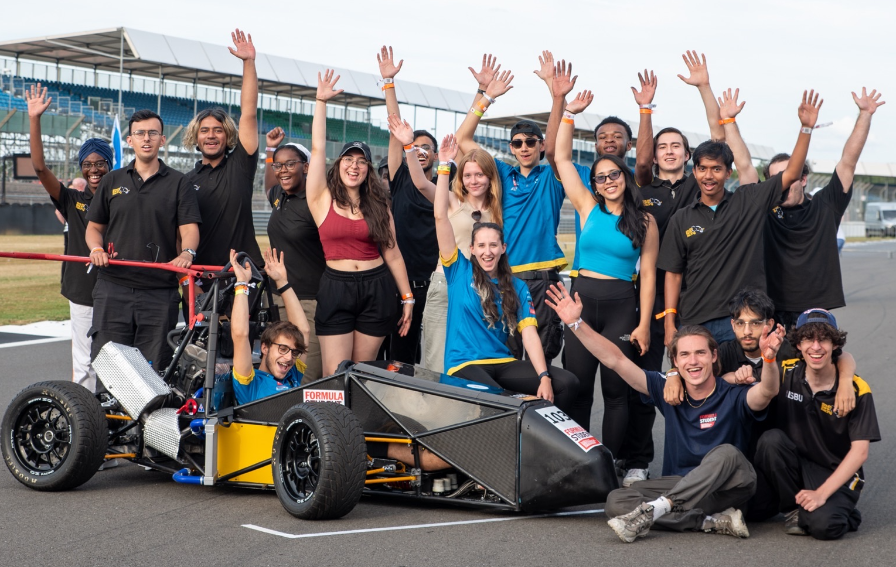
- From AI machine learning boot camp to silent film processing, there is a range of extracurricular activities for Engineering students to get involved in.
- *Accredited by The Institution of Engineering and Technology (IET) on behalf of the Engineering Council for the purposes of partly meeting the academic requirement for registration as a Chartered Engineer.
| ModeFull-time | Duration3 years | Start dateSeptember | Application codeH610 | Application method UCAS |
| ModeSandwich | Duration4 years | Start dateSeptember | Application codeH610 | Application method UCAS |
| ModePart-time | Duration4 years | Start dateSeptember | Application code5608 | Application method Direct to LSBU |
Course Accreditations
-
IET
Watch our video to see how you can make yourself at home studying at LSBU.
Location
London South Bank University student union is located at 103 Borough Rd, London SE1 0AA.
If you are visiting our Southwark Campus, you may wish to use our downloadable campus map (PNG File 466 KB). For information on accessibility, see our DisabledGo access guides. See our location page for more details.
Entry Level Requirements
Need further information? Call us on 0800 923 8888 to discuss entry requirements.
- 120 UCAS points including Maths and Physical Science. Visit UCAS for guidance on the tariff.
- A levels in Maths and Physical Science or equivalent.
- GCSE Maths grade C or above or equivalent (reformed GCSEs grade 4 or above).
If you do not meet the entry criteria above we also review any previous skills, knowledge or experience you have gained outside of your education and are happy to talk through any extenuating circumstances you feel relevant. You may also be interested in our Electrical and Electronic Engineering with Foundation Year (BEng Hons) programme which has lower entry requirements.
Choose your country
Select country here:
Missing English and Maths qualifications?
If you do not have the required English and Maths qualifications needed to satisfy the entry requirements for this programme, we have courses available at our partner College that you can take to upskill in these areas. Find out more at South Bank College.
Advanced entry
If you have already completed some studies at another university, we may be able to consider you for advanced entry. Please see our advanced entry page for more information.
United Kingdom
£9790
Tuition fees for home students
International
£17400
Tuition fees for international students
Tuition fees are subject to annual inflationary increases. Find out more about tuition fees for Undergraduate or Postgraduate courses.
-
Part-time
part-time
BEng (Hons) Electrical and Electronic Engineering (PT) - Year 1
UK fee: £7335 International fee: £13050 AOS/LSBU code: 5608 Session code: 1PS00 Total course fee: * The full amount is subject to fee increases, the total shown below is based on current fees.
UK: £29340 International: £52200 BEng (Hons) Electrical and Electronic Engineering (PT) - Year 2
UK fee: £7335 International fee: £13050 AOS/LSBU code: 5608 Session code: 2PS00 Total course fee: * The full amount is subject to fee increases, the total shown below is based on current fees.
UK: £29340 International: £52200 BEng (Hons) Electrical and Electronic Engineering (PT) - Year 3
UK fee: £7335 International fee: £13050 AOS/LSBU code: 5608 Session code: 3PS00 Total course fee: * The full amount is subject to fee increases, the total shown below is based on current fees.
UK: £29340 International: £52200 BEng (Hons) Electrical and Electronic Engineering (PT) - Year 4
UK fee: £7335 International fee: £13050 AOS/LSBU code: 5608 Session code: 4PS00 Total course fee: * The full amount is subject to fee increases, the total shown below is based on current fees.
UK: £29340 International: £52200 -
Full-time
full-time
BEng (Hons) Electrical and Electronic Engineering (FT) - Year 1
UK fee: £9790 International fee: £17400 AOS/LSBU code: 5607 Session code: 1FS00 Total course fee: * The full amount is subject to fee increases, the total shown below is based on current fees.
UK (excluding any optional years): £29370 UK (including any optional years): £29370 International (excluding any optional years): £52200 International (including any optional years): £52200 BEng (Hons) Electrical and Electronic Engineering (FT) - Year 2
UK fee: £9790 International fee: £17400 AOS/LSBU code: 5607 Session code: 2FS00 Total course fee: * The full amount is subject to fee increases, the total shown below is based on current fees.
UK (excluding any optional years): £29370 UK (including any optional years): £29370 International (excluding any optional years): £52200 International (including any optional years): £52200 BEng (Hons) Electrical and Electronic Engineering (FT) - Year 3
UK fee: £0 International fee: £0 AOS/LSBU code: 5607 Session code: 3FS00 Total course fee: * The full amount is subject to fee increases, the total shown below is based on current fees.
UK (excluding any optional years): £29370 UK (including any optional years): £29370 International (excluding any optional years): £52200 International (including any optional years): £52200 BEng (Hons) Electrical and Electronic Engineering (FT) - Year 4
UK fee: £9790 International fee: £17400 AOS/LSBU code: 5607 Session code: 4FS00 Total course fee: * The full amount is subject to fee increases, the total shown below is based on current fees.
UK (excluding any optional years): £29370 UK (including any optional years): £29370 International (excluding any optional years): £52200 International (including any optional years): £52200
For more information, including how and when to pay, see our fees and funding section for undergraduate students.
Please check your fee status and whether you are considered a Home, EU or International student for fee-paying purposes and for our regulatory returns, by reading the UKCISA regulations.
See our Tuition Fees Regulations (PDF File 630 KB) and Refund Policy (PDF File 775 KB).
Possible fee changes
The University reserves the right to increase its fees in line with changes to legislation, regulation and any government guidance or decisions.
The fees for international students are reviewed annually and the University reserves the right to increase the tuition fees to reflect increased costs of delivery and to maintain an a high-quality student experience. This increase would be no more than Consumer Prices Index (CPI) increases plus 5%.
Scholarships
We offer several types of fee reduction through our scholarships and bursaries. Find the full list and other useful information on our scholarships page.
Are you an international student looking to kickstart your global career at LSBU? If so, our new LSBU Future Global Graduate Awards could help you benefit from the high-quality, career focused education that LSBU offers. Find out more about our Global Graduate Awards.
International students
The course is not currently open to international students.
International applicants can apply directly to LSBU and should consult our international how to apply guide for further information on the application process and key dates.
Course delivery modes and application methods
| Mode Full-time | Duration 3 years | Start date September | Application code H610 | Application method UCAS |
| Mode Sandwich | Duration 4 years | Start date September | Application code H610 | Application method UCAS |
| Mode Part-time | Duration 4 years | Start date September | Application code 5608 | Application method Direct to LSBU |
Accommodation
Once we have made you an offer, you can apply for accommodation. You can rent from LSBU and you’ll deal directly with the university, not third party providers. That means we can guarantee you options to suit all budgets, with clear tenancy agreements and all-inclusive rents that include insurance for your personal belongings, internet access in each bedroom and on-site laundry facilities.
Or, if you’d rather rent privately, we can give you a list of landlords – just ask our Accommodation Service.
Read more about applying for accommodation at LSBU.
Finance
You don't need to wait for a confirmed place on a course to start applying for student finance. Read how to pay your fees as an undergraduate student.
Prepare to start
Applicant events
After you’ve received your offer we’ll send you emails about events we run to help you prepare for your course.
Enrolment
Before you start your course we’ll send you information on what you’ll need to do before you arrive and during your first few days on campus. You can read about the process on our Enrolment pages.
On completion of this course, you'll be well equipped with a knowledge of electronics systems’ design techniques and their application in areas such as control, telecommunications, and consumer products.
Year 1
- Computational Simulations
Computational tools are central to modern engineering practice. This module introduces how engineering problems can be represented using mathematical models and explored through simulation. You will learn how simulations are built, tested and used to support engineering analysis and decision-making. Through hands-on computing workshops, you will develop confidence in modelling simple systems, interpreting results and communicating findings clearly. The skills gained are transferable across all engineering disciplines and form a foundation for later analytical and design work. Assessment method: 100% coursework. - Design and Practice
Design and Practice develops the essential academic, professional and creative skills needed for engineering study and future careers. You will explore design methodologies, creative problem-solving, teamwork and project management, alongside written communication and computer-aided design (CAD). The module introduces sustainability, professional standards and the role of engineers in industry and society. Personal development planning is embedded throughout, helping you build confidence, employability and a clear sense of direction within your chosen engineering discipline. Assessment method: 100% coursework. - Engineering Mathematics
Engineering Mathematics provides the mathematical foundation required for all engineering degrees. Designed to support students from a wide range of backgrounds, the module develops key skills needed to solve engineering problems at an early stage. You will study core mathematical techniques and learn how they are applied in engineering contexts. The module also introduces computational tools, such as MATLAB, to support problem-solving. By the end, you will be better prepared to apply mathematics confidently throughout your studies. Assessment method: 100% coursework. - Engineering Science
This module introduces the fundamental scientific principles that underpin engineering analysis and design. You will explore key concepts relating to forces, energy and physical systems, learning how idealised models are used to understand and solve engineering problems. Emphasis is placed on developing analytical thinking and problem-solving skills that apply across disciplines. The knowledge gained provides a strong foundation for later study in areas such as mechanical, thermal, structural and systems engineering. Assessment method: 100% coursework. - Materials Engineering
Materials Engineering introduces the fundamental principles governing the behaviour and selection of engineering materials. You will explore how the structure of metals, polymers, ceramics and composites influences their properties and performance. The module considers how materials are processed and chosen for real applications, balancing functionality, sustainability and cost. Learning is supported through lectures, laboratories and group activities, encouraging practical understanding and collaboration across engineering disciplines. Assessment method: 100% coursework. - Principles of Instrumentation
Measurement is fundamental to all areas of engineering. This module introduces the principles behind how engineers obtain meaningful information from real systems and use it to support analysis, design and decision-making. You will explore core ideas relating to measurement, data quality and uncertainty, alongside an overview of instrumentation used in engineering practice. Practical activities develop confidence in experimental work, data handling and interpretation, building transferable skills relevant across all engineering disciplines. Assessment method: 100% coursework.
Year 2
- Advanced Engineering Mathematics and Modelling
This module covers undergraduate advanced engineering mathematics to enable you to consider and model a variety of relevant engineering problems (e.g. electrical, mechanical, petroleum, chemical, computer, civil). Assessment methods: 50% coursework, 50% exam. - Circuits, Signals and Systems
This module introduces methods to mathematically model circuits, signals and systems required for the engineering of electrical, electronic, telecommunication and control systems. It shows how to model and analyse complex signals with Fourier series, Fourier transforms and Laplace Transforms. The direct and indirect method of convolution is used to find the time response of systems to given inputs. First and second order LTI dynamical systems are modelled with transfer functions and their zero-state and zero-input responses predicted when the inputs are any function of time. The frequency responses of some common LTI two port filter circuits are studied. A MATLAB/SIMULINK workshop enables understanding of signal synthesis using the Fourier series, finding the frequency spectra of complex and noisy signals using FFT, and the time response and the frequency response of systems. Assessment methods: 30% coursework, 70% exam. - Principles of Control
This module aims to give a sound understanding of a range of topics in Control Systems Engineering. It will impart methods to model and analyse dynamical systems met in the engineering of systems such as robotics, automobiles, aircraft, automatic machinery, chemical process plant, etc. It will teach you to determine the stability of a system and to predict system responses in the time domain (transient and steady state) and in the frequency domain, as well as to handle the interconnection of many Single Input Single Output systems connected in feedback and feed forward configurations. The module will provide you with methods to specify supervisory control and data acquisition systems, and to modify the behaviour of a given system by using feedback control to improve stability, to make the system act quickly and precisely, and to reduce the effect of disturbances. Learning will be supported by a laboratory workshop that enables the study of control systems using both analysis methods and computer simulation using MATLAB and SIMULINK. Assessment methods: 30% coursework, 70% exam. - Analogue Electronics
This module develops advanced techniques in analogue electronic design covering discrete (BJT / FET) and opamp related circuitry design, simulation, prototyping and testing. The aim of this module is to develop broad knowledge and experience in analogue circuit design from first principles and using SPICE related tools. Assessment methods: 50% coursework, 50% exam. - Embedded Software Design
This module concentrates on teaching students to understand the basics of embedded systems hardware and software, and to develop the techniques in data acquisition and manipulation required for instrumentation and control applications. Embedded systems hardware and software design for rapid electronic prototyping will be covered. Further, it will solidify lectures with experimental assignment projects based on Arduino microcontroller kits. Specifically, the module will focus on practical interfacing, coding (in C/C++), signal acquisition, processing and display. There will be an independent open-brief project in the last part of the module intended to test the student’s embedded systems design and problem solving skills. Assessment methods: 100% coursework.. - Professional Practice and Team Design Project
This is a skills-based module developing students' understanding of the design process within engineering, including factors that need to be taken into account in identifying and meeting requirements for new products, i.e. outcomes of processes; working within Regulatory, professional and Standards requirements; developing practical skills; working as part of a team; handling information; project planning and management; and report-writing and presentation skills. Assessment methods: 100% coursework.
Year 3
Optional placement year
Year 4
- Renewable Energy Engineering
This module establishes the students’ knowledge in all types of renewable energy systems. It provides cornerstone renewable energy engineering skills required in the fields of electrical and electronic engineering and electrical power engineering. The contents entails calculations and measurement methods of solar radiation and the theory of photovoltaics and its performance parameters. These will be applied in designing and analysing the photovoltaic technologies. This module also enlightens the design, development and performance analyses of wind energy technologies. Students’ will also advance their knowledge of smart grid interconnected wind energy and photovoltaic systems, supported by workshop experiments. - Communication Systems and Wireless Technologies
This module provides a deep understanding of modern communication theory, performance analysis and design of various communication systems. It also gives an overview of recent progress in broadband access technologies and evolution of wireless communication systems. Lectures cover concepts of transmission media, classification of communication systems, microwave transmission lines, fundamentals of antennas, radio wave propagation through space, modulation and multiplexing techniques, configurations of typical microwave transmission links/systems, power budget analysis, wireless transmission impairments, architectures and implementation of present and future wireless communication systems, respectively. Particular emphasis is given to design approaches and applications of current wireless communication systems. - Biomedical Electronics
This module aims to provide students with the in-depth understanding of modern medical electronics. Through lectures, tutorials and laboratory sessions, the module describes how biomedical electronics are used, and exemplar applications are discussed. - Embedded Systems and the Internet of Things
This module presents the nature and characteristics of embedded systems and the Internet of Things (IoT). It presents techniques for embedded applications, parallel input and output, serial communication, interfacing, interrupt handling, applications involving data acquisition, control, sensors, and actuators, embedded micro controllers, implementation strategies for complex embedded systems. It is discussed advanced challenges in embedded systems design using contemporary practice; interrupt driven, reactive, real-time, object-oriented and distributed client/server embedded systems. It is further discussed how IoT connects devices and various systems aiming to understand that it is a network of multiple connected physical objects, the things, involving myriad of applications. - BEng Project
The individual major project requires students to plan, execute,review and report upon a major piece of technical work directly related to their degree discipline. In this regard, it provides students with the opportunity to develop a high degree of subject specific expertise.This module differentiates from others on the course taken due to the high degree of autonomous study expected. This flexibility should be seen as an opportunity to explore new areas of interest and to acquire new and often unexpected skills. The work undertaken within the project will require students to develop their own methodologies in advance of presenting solutions to the studied problem.
Assessment
Each module has a number of assessment components, usually, but not always, two. These can consist of assignments, mini-tests, essays, laboratory reports and logbooks and examinations of various kinds. The assessment components for each module are specifically defined and kept up to date in the current Module Guide. Note that a component is not necessarily a single piece of work - several pieces of coursework (often referred to as a portfolio) may constitute a single component of the module assessment.
To pass a module, students must obtain an overall module mark of no less than 40% and also a minimum threshold mark of 30% in each component. The weighting of each component for calculating the overall module mark is given in the Module Guide, and the module coordinator (or leader or lecturer in charge) will often cover the details of this at the beginning of the delivery of the module.
Facilities
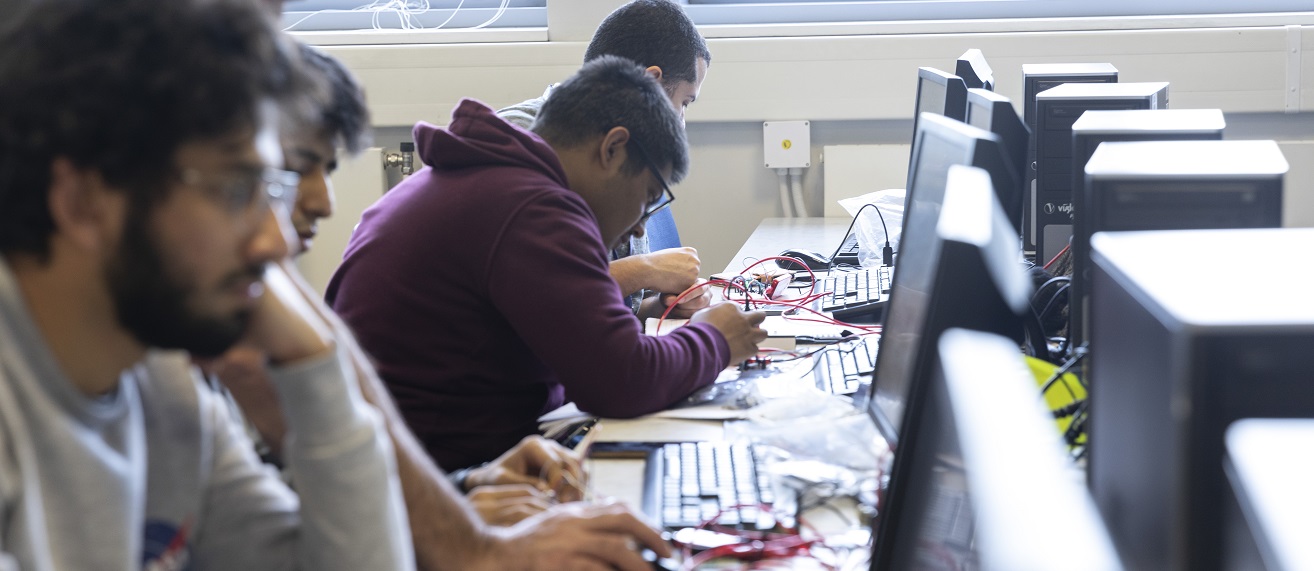
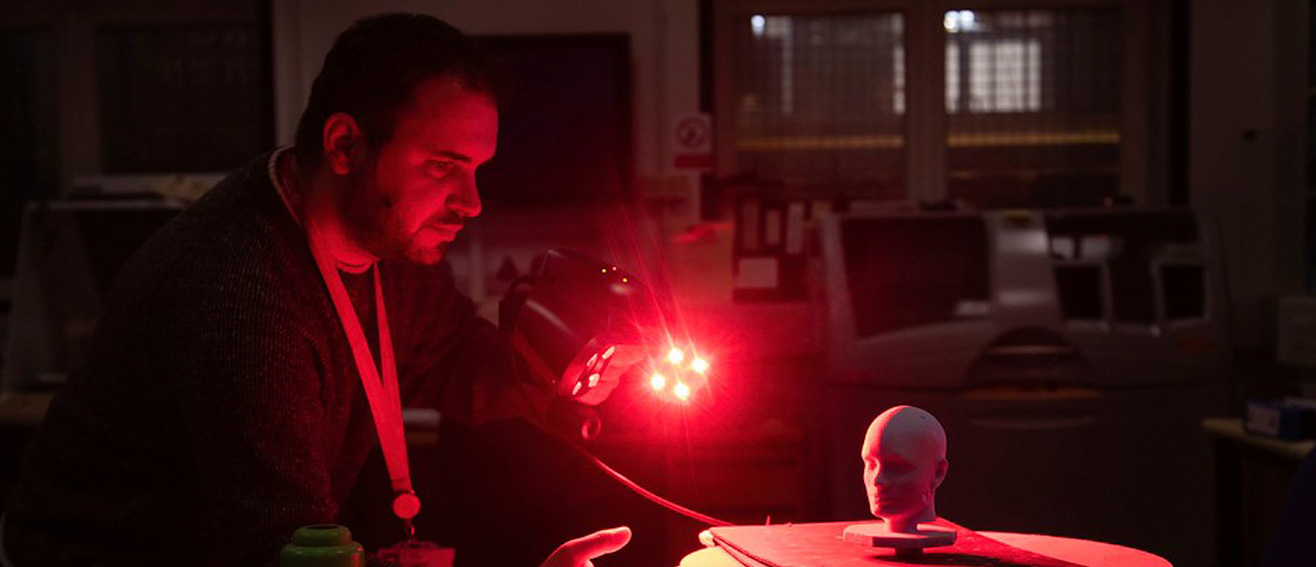
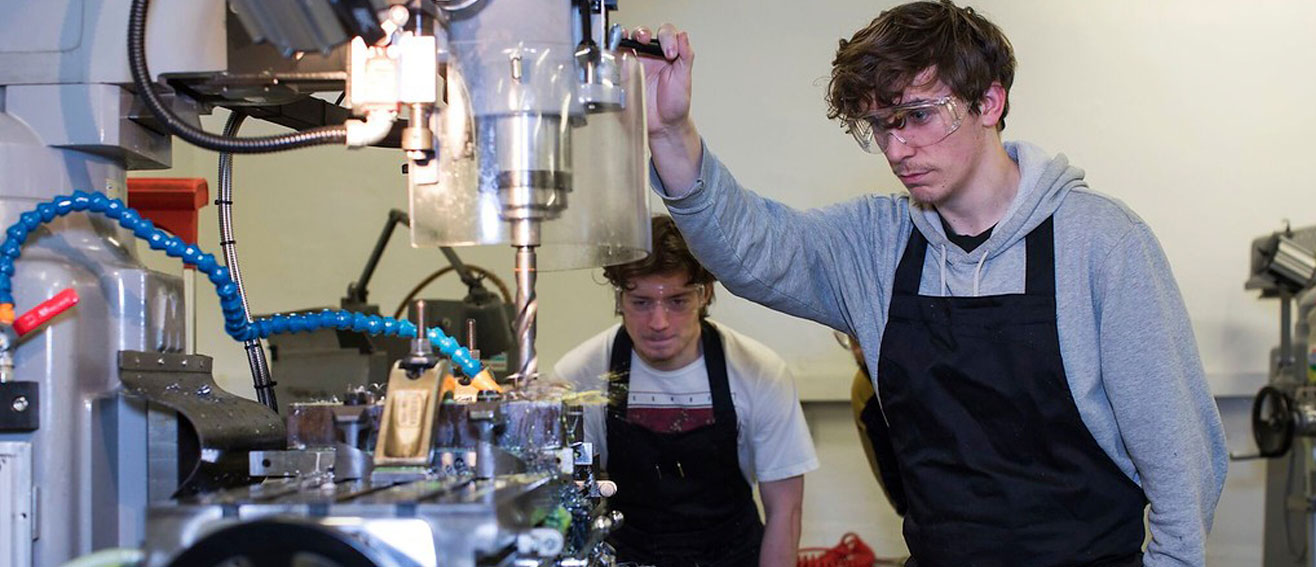
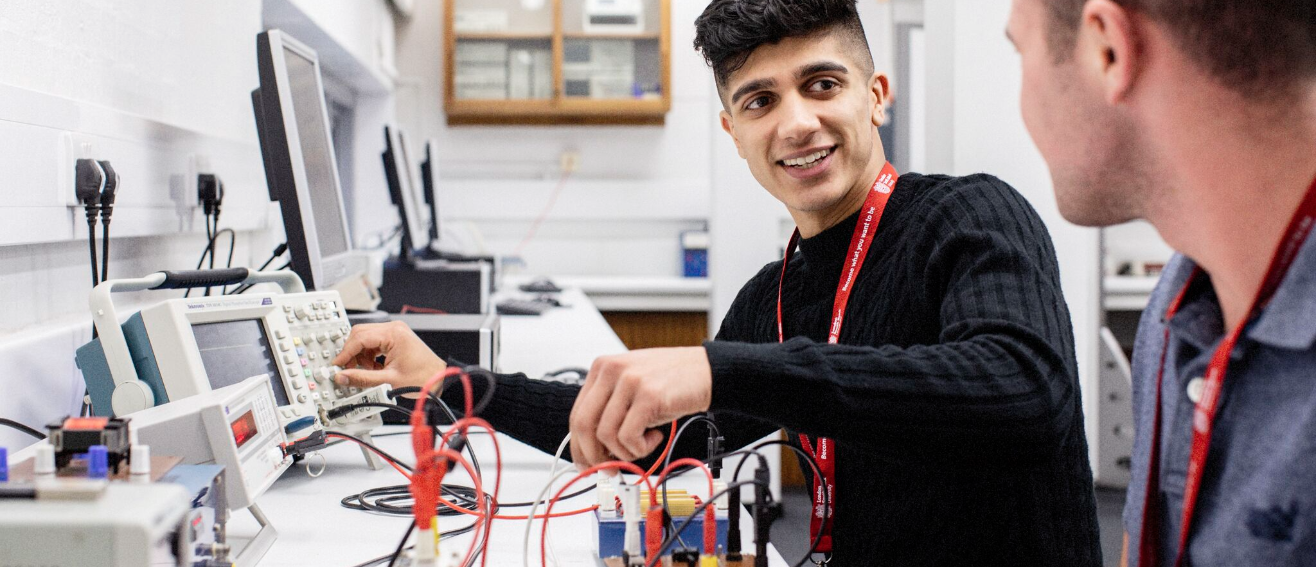
Access to five teaching labs each with dedicated professional technical staff and all equipped with generic electrical and electronic instruments and equipment for building and measuring experiments including parts for building prototypes, soldering, etc. There is an extra room that acts as a project lab for electrical/electronic workshop in your final year individual project. Access is also available for mechanical workshop for building products from prototypes including 3D printing. Most computer software installed in our teaching labs is also available 24/7 for external access from home (Windows PCs/laptops mostly).
Read more about our laboratories and industry-standard software.
Facilities
Access to five teaching labs each with dedicated professional technical staff and all equipped with generic electrical and electronic instruments and equipment for building and measuring experiments including parts for building prototypes, soldering, etc. There is an extra room that acts as a project lab for electrical/electronic workshop in your final year individual project. Access is also available for mechanical workshop for building products from prototypes including 3D printing. Most computer software installed in our teaching labs is also available 24/7 for external access from home (Windows PCs/laptops mostly).
Read more about our laboratories and industry-standard software.
Careers
Employability Service
At LSBU, we want to set you up for a successful career. During your studies – and for two years after you graduate – you’ll have access to our Employability Service, which includes:
- An online board where you can see a wide range of placements: part-time, full-time or voluntary. You can also drop in to see our Job Shop advisers, who are always available to help you take the next step in your search.
- Our Careers Gym offering group workshops on CVs, interview techniques and finding work experience, as well as regular presentations from employers across a range of sectors.
Our Student Enterprise team can also help you start your own business and develop valuable entrepreneurial skills.
This course will prepare you for a career within many fields of electrical and electronic engineering where electronic systems are in use, such as embedded control systems where large scale integrated circuits are developed ad-hoc and/or integrated with programmed solutions into a whole system to automate the control of complex processes.
Recent graduates from this course have gone onto roles in the transport, entertainment, medical, public sector, public services and supply industries.
Employment based on sector
Employment areas across the following industries include:
Transport
Instrumentation, signalling, power distribution, track maintenance, ECU upgrading/testing and safety critical systems
Entertainment
Antennae design, vision mixing, studio design, satellite systems, remote control, lighting control and maintenance, robotics control and design, computer interfacing and embedded control
Medical
Instrumentation design and maintenance, prosthetics design, light/heat/humidity control systems, remote control (robotic surgery platform) monitoring and security system design maintenance
Public sector
Security systems, traffic signalling, wireless control systems, GPS design, autonomous robotic vehicle designs (mine-sweeping. bomb disposal) and surveillance system design
Public services and supply industries
Water, gas, electricity, sewerage and waste-disposal – modernisation and control of distributed services, testing and quality checking and safety systems
What to expect from your career
Electrical and electronics engineers can find themselves working in all kinds of environments and sectors. You might work in a production plant, workshop, office, laboratory, or on site with a client.
Engineers can be involved in a project from its inception and often find themselves involved in maintenance programmes too. Sometimes they specialise in a particular part of the process and on other occasions are involved at every stage. They tend to work in multi-disciplinary teams with engineers from other areas, as well as architects, marketers, manufacturers, technicians and more.
Typical tasks include identifying customer and user needs, designing systems and components, researching solutions and estimating costs and timescales, making prototypes, designing and conducting tests, ensuring safety standards are adhered to and modifying and improving and maintaining the product once it is finished.
A degree from LSBU in electronics paves the way to Chartered engineers status that can make you earn between £40,000 and £50,000 per year, and in some cases you can earn even more.
Gaining key employability skills
Our vocational and practical approach to teaching will have a positive impact on your employability. As a graduate you'll have a number of practical key skills that will make you an attractive prospect to employers. These include the ability to complete analytical investigative work, knowledge of both analogue and digital systems, the ability to create computer models for simulation, and the ability to manage projects using industry standards and specifications. Taking up the opportunity of a sandwich year in industry will further improve your employment prospects as a new graduate.
Continuing to postgraduate studies
Graduates will be able to apply for further study at postgraduate level, including for a place on our full-time or part-time MSc Electrical and Electronic Engineering.
The course follows the UK SPEC.
Over the last 30 years, BEng (Hons) Electrical and Electronic Engineering course has been accredited by the Institution of Engineering and Technology on behalf of the Engineering Council for the purposes of fully meeting the academic requirement for registration as an Incorporated Engineer and partly meeting the academic requirement for registration as a Chartered Engineer.
Several academics have funded projects as well as KTPs. Our EEE staff include the Director of Research for the School and lead two of the three research centres of the Schools; each one with industrial collaborators with access to state-of-the-art research facilities.
The division maintains an Industrial Advisory Board which is composed of five professionals engineers working in the industry in various capacities and who meet twice a yar to offer advice and feedback on our courses with an industrial viewpoint.
Value of professional accreditation
An accredited degree will provide you with some or all of the underpinning knowledge, understanding and skills for registration as an Incorporated (IEng) and with work experience and professional development as a Chartered Engineer (CEng).
Some employers recruit preferentially from accredited degrees, and an accredited degree is likely to be recognised by other countries that are signatories to international accords.
IET membership
All students are granted student membership of the IET on enrolment for the duration of the course for no extra cost. Benefits include access to IET resources, career opportunities and support, and a dedicated student and apprentice online zone where you will find study resources, news, guidance and more. Plus, you'll be part of a large professional network, so you can begin to grow your contacts.
History and expertise
LSBU has been educating professional engineers for over 100 years. We know that industry is continually expanding into new areas and technology is rapidly developing and changing and we are proud to play a vital role in these developments.
The growth in global communications, global warming and the need to find alternative energy sources have identified new areas of importance in the practice of engineering and product design. Our courses are designed with these issues in mind and are focused on academic content and real-life applications so our graduates are appropriately equipped for future employment and/or postgraduate studies.
European placement opportunity
The European Studies endorsement is available on all our BEng courses. If you choose to complete a sandwich year abroad you will study at one of our partner institutions in Europe, and then complete the year with an industrial placement.
Teaching and Assessment
Our teaching staff have a great deal of experience. Whether they are teaching, carrying out research or involved in consultancy, they have the skills to make a difference to all our students. You will learn in a modern, well-equipped environment complete with sophisticated technology.
The course is delivered with the traditional approach of lectures in lecture theatres and practical work in workshop and labs with electronic equipment. Session for so-called tutorials is also timetabled. Roughly each 20-credit module has around 5 hours of contact time per week over a period of 12 weeks or around 50-60 hours per semester. Lectures is for all students while workshops are for groups no larger than 30 students. Lectures are recorded and all material distributed via vle.lsbu.ac.uk portal.
Modules are assessed by exam and/or coursework so that the balance overall is around 60% of coursework and 40% in written examinations.
In Year 1 and Year 2 each student is allocated a personal tutor and in Year 3, the BEng Project supervisor acts as the personal tutor. Tutor and Tutee meet at least twice per semester.
Approach to learning
You'll learn through lectures, seminars, tutorials and practical work. Taking on both group and individual projects, we assess your work through a mixture of coursework and exams, with project and laboratory work counting towards your final award. We also teach you the life skills of effective communication, problem solving, project planning and team working that will set you apart and give you the best chance of getting the job you want after you graduate.
Hands-on engineering
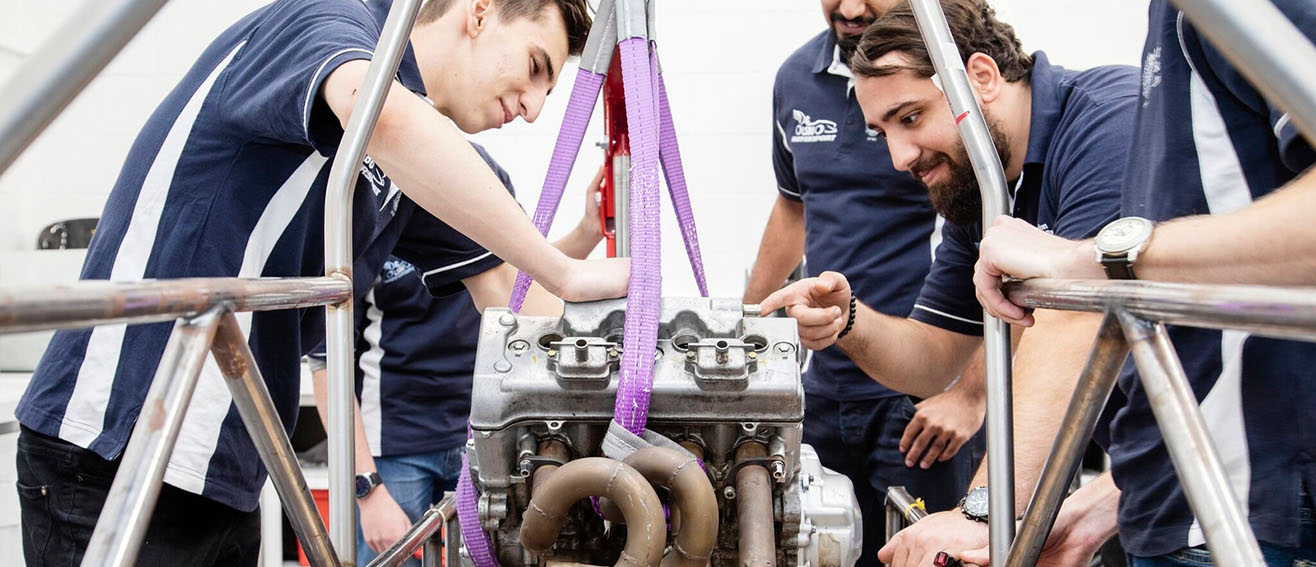
The amount of project-based learning that you'll do on an engineering degree varies from university to university. At LSBU we offer 'design-make-test' projects throughout the degree course rather than concentrating them all into your final year. This means that you'll adapt theoretical principles to solve real-world engineering problems very early on in your university career. This experience of delivering innovation makes you attractive to employers. Innovation is at the very heart of what an engineer does on a day-to-day basis. Engineers look for practical ways of making things better, more efficient, cheaper, safer, stronger, more resilient, quicker, more integrated and more effective. Our engineering courses will teach you first-hand how to develop these crucial skills and traits.
Prepared for modern engineering practice
In reality most engineers will find themselves working side-by-side in multi-disciplinary project teams. One of the greatest professional assets that you can have is the ability to function well in this team set-up. That's why some of our modules are shared across all our engineering courses. These modules are about understanding the commercial priorities that shape engineering practice and problem-solving. Guest lecturers from world-renowned companies, such as Rolls-Royce, have lectured on these modules.
| Lectures, seminars and lab-based study | Self-directed study | |
|---|---|---|
| Year 1 | 31% | 69% |
| Year 2 | 37% | 63% |
| Year 3 | 24% | 76% |
Personal Tutoring
As an Engineering student, you will be allocated a named tutor during your first three weeks at LSBU. The role of your tutor is to be your primary contact for academic and professional development support.
Your tutor will support you to get the most of your time at LSBU, providing advice and signposting to other sources of support in the University.
They should be the first person at the university that you speak to if you are having any difficulties that are affecting your work. These could be academic, financial, health-related or another type of problem.
You will have appointments with your personal tutor at least twice a semester. Some meetings will be one-to-one and others will be in small groups. You can contact your tutor for additional support by email or in person.
Register your interest
Gecko content requires marketing cookies
This content is provided by a third party. To view it, please enable marketing cookies. This may involve the processing of personal data.