

LSBU’s DARLAB presents Bio-Lattice at the Venice Biennale of Architecture 2025
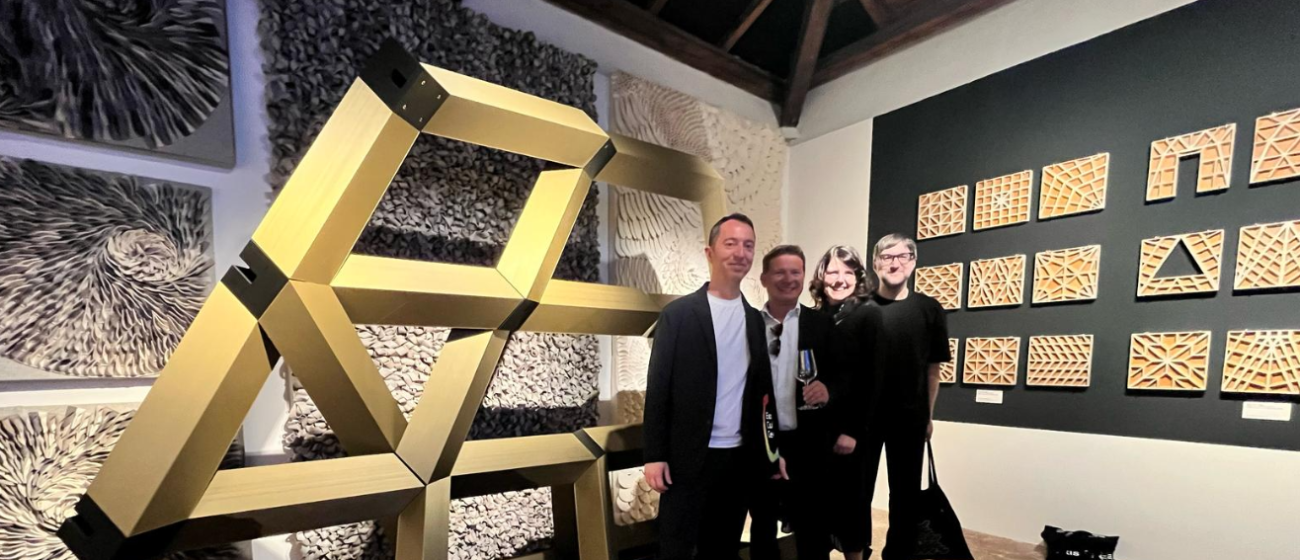
A 3D-printed sustainable installation from LSBU’s Digital Architecture and Robotics Laboratory (DARLAB) is showcased at the European Cultural Centre’s Venice Biennale exhibition, exploring how advanced manufacturing can reshape the future of construction.
By Federico Rossi and Ottavia Rispoli, Digital Architecture and Robotics Laboratory (DARLAB), LSBU
A new model for sustainable construction
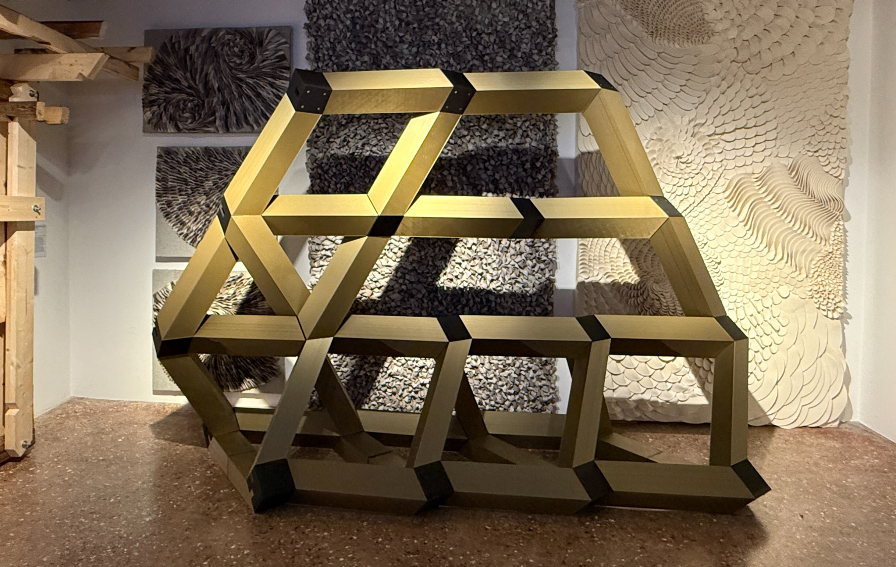
London South Bank University’s Digital Architecture and Robotics Laboratory (DARLAB) has been invited to exhibit its latest research project, Bio-Lattice, at the Venice Biennale of Architecture 2025, hosted at Palazzo Mora by the European Cultural Centre (ECC). Bio-Lattice is a large-scale 3D-printed installation that investigates how sustainable materials, robotics, and computational design can be combined to rethink architectural production. Developed using recycled PETG polymers, the installation demonstrates how additive manufacturing can help reduce waste, promote circular economy principles, and create resource-efficient material systems for the built environment.
“Bio-Lattice represents not only a step forward in sustainable architectural design but also a demonstration of how universities, industry, and design practices can work together to deliver tangible innovation,” — Federico Rossi, Associate Professor in Architecture and Digital Manufacturing, LSBU.
Research through making
The project builds upon DARLAB’s ongoing research into digital tectonics, lightweight fabrication, and material circularity. Its geometry, inspired by natural lattices, achieves both structural efficiency and aesthetic refinement, combining design computation with robotic extrusion.
Senior Lecturer Ottavia Rispoli, who co-led the structural development, explains:
“We chose recycled PETG polymers because they are durable, accessible, and sustainable. This allowed us to test the limits of large-scale 3D printing while keeping environmental responsibility central. The insights gained will inform future research into bio-based and composite materials.”
Collaboration across disciplines
The Bio-Lattice team brought together expertise across LSBU and the design industry. Led by Federico Rossi (DARLAB, Architecture), the project involved Prof. Steve Dance (Engineering), Ottavia Rispoli (Structural Engineering), and Marco Vanucci (Architecture and Design Practice), with support from industry partners AKT II (Structural Engineers) and Anne Kyyrö Quinn (Textile Design Studio).
“Collaboration was critical,” says Rispoli. “The synergy between architecture, engineering, and design turned technical challenges into opportunities for innovation. Working together enabled us to test new material and fabrication strategies at full scale.”
Challenges and discoveries
The design and fabrication process presented several technical challenges, including assembly tolerances, node interlocking, and the variable performance of recycled polymers during extrusion. Through continuous prototyping and testing, the team developed solutions that improved precision and structural reliability. These outcomes now inform DARLAB’s broader investigations into modularity, resilience, and circular fabrication systems.
“Every challenge was an opportunity to learn,” notes Rossi. “Each iteration deepened our understanding of material performance and digital manufacturing workflows.”
Inspiring LSBU students
Projects such as Bio-Lattice are deeply embedded in LSBU’s teaching and learning environment. The laboratory’s research directly informs modules in architecture, design, and engineering, giving students exposure to emerging technologies and sustainable material systems.
“We want students to dare, experiment, and aim high,” says Rossi. “Seeing their lecturers and researchers presenting at the Biennale shows that ambition and creativity can lead to global recognition.”
Rispoli adds: “Integrating live research into the curriculum bridges the gap between theory and practice. Students experience how innovation, sustainability, and collaboration drive the future of architecture and construction.”
Looking to the future
For Federico Rossi, Ottavia Rispoli and the DARLAB team, Bio-Lattice marks a significant step in the evolution of sustainable digital manufacturing for architecture. The research points towards modular, disassemblable, and low-waste systems that could redefine how buildings are designed and constructed.
Bio-Lattice will remain on display in Venice until November 2025, before returning to the UK for a public dissemination event, engaging industry partners, researchers, and the wider community.
“The Biennale has given our research international visibility,” concludes Rossi. “It reinforces LSBU’s mission to lead through innovation and to promote a more sustainable, technologically empowered future for the built environment.”
Exhibition: European Cultural Centre, Personal Structures – Venice Biennale of Architecture 2025, Palazzo Mora, Venice
On display: May – November 2025
Project Credits: Federico Rossi, Ottavia Rispoli, Steve Dance, Marco Vanucci, AKT II, Anne Kyyrö Quinn