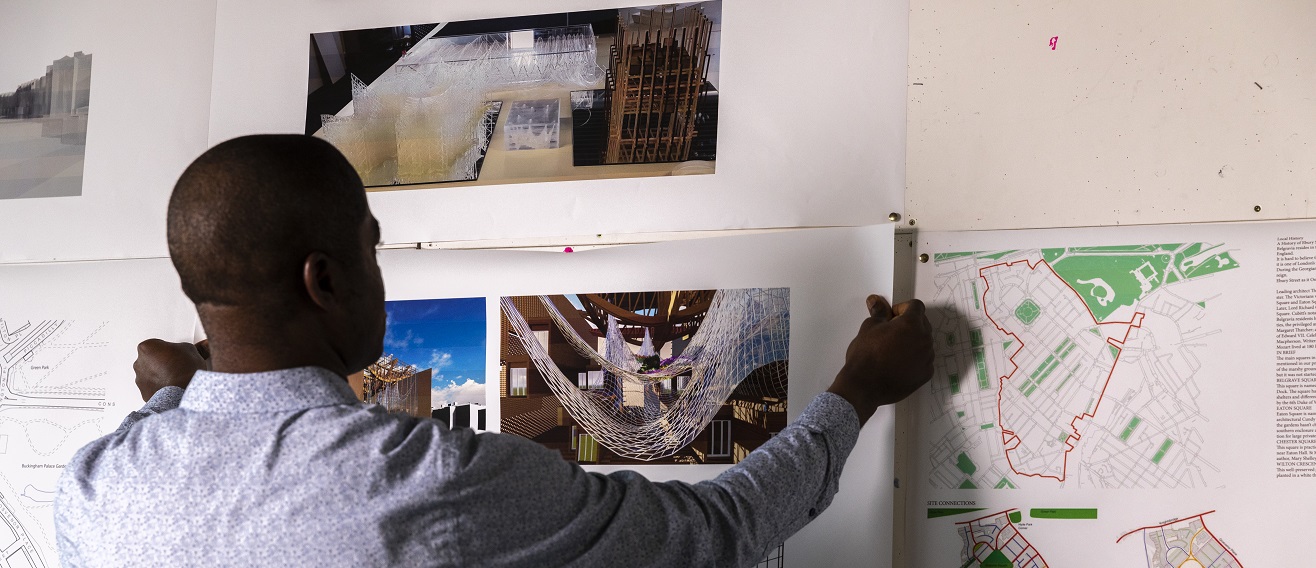





The acquisition of design skills and knowledge is central to the programme of study, and these are learnt through studio activities and the completion of design projects. A creative as well as analytical approach to designing is encouraged using models, drawings, and computer graphics to explore design concepts. As the course comprises over 50% of its content as design, it should be understood success in this curricular area is central to the course.
Studio activity also includes learning how to communicate ideas, both verbally and visually, to tutors, students, and fellow apprentices. The presentation of work and the feedback received is referred to as a crit, or review of your work. The crit/review is an opportunity to explain an individual approach to the design process and to clarify ideas; attendance at all crits/reviews is essential. At the crit/review, everyone will receive verbal and written feedback from tutors and guest critics responding to the project that has been reviewed. At interim and final crits apprentices will usually be given a crit sheet by the studio tutor to serve as a reflection of the work’s quality and to give guidance that must be responded to.
Construction and environmental technologies are integral parts of the design process from conceptual idea to final proposal. At undergraduate level, the principles of these technologies are learnt and this knowledge then developed and applied to key design projects in the programme. The technology and environment syllabus is delivered in lectures, and then assessed by means of coursework as an integral but discreet part of design studio work. Apprentices can use their knowledge of these technologies as a driver in their architectural thinking, or subsumed by other design influences.
The cultural context input comprises History and Theory courses. The history and theory courses position the individual student experience within the wider subject area of architecture, establishing views regarding the role of architecture within culture, the ethical and rational critique of architecture, and the application of philosophical thought to architecture.
As well as establishing rigour in thinking, critical investigation, the application and organisation of research, writing skills, and referencing, studies in the history and theory of architecture encourage students to be aware of precedent. Precedent refers to the analysis of previous works of architecture, and how diverse design methodologies inform your own proposals in the studio. Historical and theoretical understanding allows students to judge the relative success of various design approaches against criteria including building performance, scale, form, social consequence, and historical significance.
Communications involves both analogue drawing and modeling, and the acquisition of advanced digital design skills. Communications 1 introduces 2D and 3D analogue and digital drawing; Communications 2/Digital Media covers the basics of 3D computer modeling and fabrication, and is connected to development of a design project. The teaching of advanced digital drawing software is an essential part of employment in an architect’s office. Apprentices are required to supplement all taught workshops with extensive, self-managed practice in all digital technologies.
All apprentices are introduced to professional practice through a series of lectures and case studies. The views of practitioners, and of representatives from the professional and statutory bodies are both represented in the lecture series. Apprentices are required to manage and appraise their own working practices with regard to their work. They are taught how to prepare a CV, and to search for work (where relevant). Apprentices are also encouraged to participate in the RIBA Mentoring Scheme which will again be offered to FT3 and PT5 students (as well as apprentices) this year.