Book an open dayGet info and updates

icon_cup_red.svg

Guaranteed clinical experience: every student gets hands-on work in our award-winning Law Clinics, helping real people with real cases.

icon_rocket_red.svg

Built-in career prep: every module is designed to grow the skills and confidence you’ll need for your future legal career.

icon_people_red.svg

Teaching excellence: learning from academics who are great at explaining things and make the subject come to life (we’ve scored 95% for Teaching Clarity with the NSS 2025).

Overview

Real cases, real people, real impact

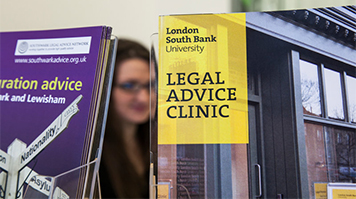
At LSBU, you don’t just learn law, you do law. We’re the first Law School in the UK that guarantees you’ll work in one of our in-house clinics, where you’ll be advising real people in our community on housing, family, employment, consumer rights, and social justice issues through our Legal Advice, Human Rights, and Law & Social Policy clinics, all right here in central London. This practical experience will help you build your confidence, your CV and your professional network before you even graduate.

You’ll see the law in action, with teaching that’s built around practice as much as it is theory, leading to many of our graduates making lasting impacts in their communities, some have even gone on to argue cases in the Supreme Court or contribute to social justice campaigns. This kind of real-life experience will give you the practical skills, professional connections and self-confidence to succeed as a lawyer, barrister or solicitor, or in plenty of other professional settings.

Meet Mohammed, a Law student at LSBU

The knowledge and skills you build through your studies, combined with our Law Clinic Guarantee, expert academics and the CareerSmart programme, mean you’ll always have the support and guidance you need to aim higher. You will be supported by experienced  academics, practitioners,  peer mentors and professional support services. All, while getting access to a range of resources that set you up for success.

These include Oxford University Press Law Trove (185 titles worth £8,000, free to you), leading databases: LexisNexis and Westlaw UK, high quality support in research, evaluation, and application processes. Strong links with the South London Law Society and the Southwark Legal Advice Network. Beyond the classroom, you can join our award-winning Bar & Mooting Society, the Student Law Society, or write for The Devil’s Advocate, our student-led magazine.

Are you ready to stand up, speak out, and make change? Your journey starts here.

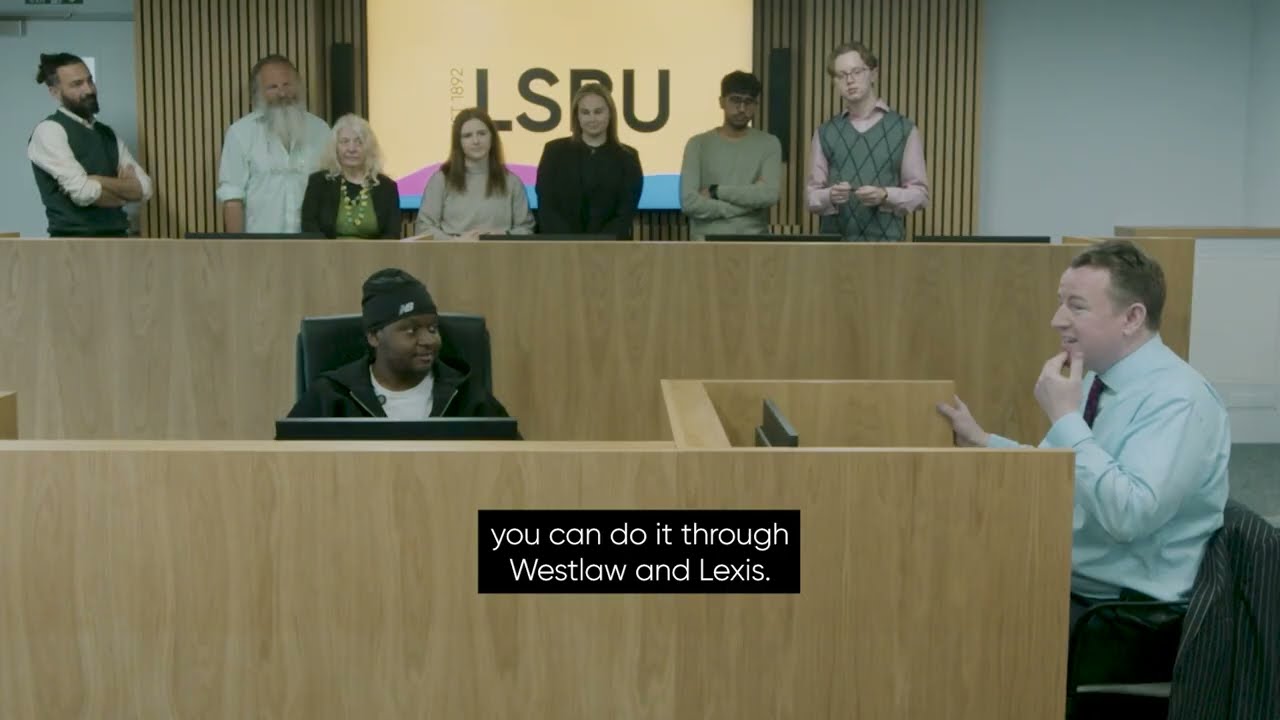
Watch the 'Introduction to Law at LSBU' from our virtual applicant day

Not everyone takes the same route into higher education and that’s perfectly fine. If you’ve already completed a Level 5 qualification, such as an HND or Diploma in Law, or studied two years of an undergraduate law degree elsewhere, this Top-Up course offers the opportunity to complete your academic journey and gain a full LLB (Hons) qualification with London South Bank University.

During your Top-Up year, you’ll study a carefully designed combination of final-year modules from our LLB (Hons) Law degree. These include core subjects such as Land Law and The Law Project, alongside a range of elective options from Business Law and Employment Law to Family Law and Human Rights Clinic allowing you to build expertise in your chosen area of interest.

This structure ensures that you graduate with both the in-depth legal knowledge and the practical, research, and analytical skills needed to progress toward professional legal training or careers across the wider legal and corporate sectors.

Meet Trent, A Law student in the Legal Advice Clinic and moot room

Is this course right for me?  

Our teaching is built around practice, not just theory. That’s why our students consistently rate us highly in the National Student Survey 2025:

  • 95.1% say our lecturers explain things clearly
  • 90.4% value our employability and practice opportunities
  • 90.2% say assessments let them show their learning

If you’re looking for a hands-on course that lets you put theory into practice, then this course is for you. If you want guaranteed experience in an award-winning Law clinic, then this course is for you. If you want a degree with a built-in focus on your future career, then this is the course for you.

Above all though, if you’re hungry to create your own version of success then LSBU is right for you. Because the making of you doesn’t begin and end with just your degree, everything that’s brought you here today is part of your story; your experiences, the life you’ve lived, the skills you’ve gained and the goals you’re chasing.

Not only do we see this, but we value that in you. We’re not in the business of forcing you into moulds, instead we’re here to help you break them. If you’re ready to embark on a journey of hard work, fulfilment and self-discovery, then Law at LSBU is definitely right for you.

Apply Now.

Does this sound like the right fit for you? Then read on to discover our course content.

Course Content

What will I learn?

Before you start your final year with us, we’ll get to know you on a personal level, your strengths, interests and passions. We’ll help you identify speciality areas where you’re most likely to succeed and will help you achieve these goals with tailored insight.

There is capacity within the Top Up Course to ‘bespoke’ arrangements for students who are missing a Foundation of Legal Knowledge, and add such a module to their profile.  This is important for students wanting to go on to complete the Barrister route to qualification who are required to have completed 7 Foundation of Legal Knowledge to obtain a qualifying Law Degree. For advice on this, please approach the Course Leader.

Please note that if you opt for a bespoke arrangement, there may be changes to the modules that you would be following during your final year.

You can find a detailed look at each of the modules below. Next, let's explore how you will learn.

Course module list

The LLB (Hons) Law covers the core legal topics with a selection of options covering specialist areas of law, procedure and professional skills.

All modules carry 20 CAT credits.

Please note that although most optional modules run, we do not guarantee to run every optional module each year. Not all option combinations are available due to timetabling restrictions.

Compulsory

Students learn Land Law through an evolving story, illustrated with diagrams, and involving everyday Land Law situations. Students learn about estates and interests (both legal and equitable) in land and the formalities required to create them; the regulation of land use through private law controls; the finance of land via a mortgage; and how estates and interests in land exist and are protected in registered land. Students will, throughout their study of Land Law, apply the Law they learn to the facts of this ever-evolving Land Law story. 

Option Pool C

Students must do one module and may do two from this pool

This module teaches students some key aspects of business law in a commercial context. These are:  (1) determining which is the appropriate business form for commercial operations;  (2) using agents for the sale and purchase of goods;  (3) insolvency procedures, including rehabilitation and related director’s liabilities;  (4) protecting operations through insurance; and  (5) resolving disputes through international commercial arbitration. 

The module examines key areas of the criminal process journey first introducing the criminal process before examining Police powers and professional ethics, Police station detention and interview, criminal procedure in the Magistrates Court (including Identification evidence); and procedure and Advocacy the Crown Court.  The module also reviews the rules evidence (relevance; the discretionary exclusion of improperly obtained evidence; character; hearsay; confessions, the burden and standard of proof; opinion, privilege).  Consideration is also given to the complicated topic of sentencing and appeals.  Students are also given the opportunity to study selected issues of youth justice. 

This module explores the key principles of children law, examining law and procedure in cases involving parental disputes about children.  Consideration is given to cases requiring some intervention of the state to support children in need or to protect children from abuse or neglect and to the legal processes of adoption and surrogacy.  Throughout there is an assessment of children’s rights and examination of the significance of domestic abuse in children cases and of recent and anticipated law reform. Students participate in the familylawhub@lsbu, which provides students with opportunities for experiential learning including collaboration with external partners. 

Option Pool D

Option Pool D (students may do one option from this pool)

The module provides students with an opportunity to engage in research, analysis and professional writing, supporting human rights organisations to prepare reports and campaigns aimed at tackling specific human rights violations around the world.Law students will work in in small teams for human rights organisations to help research issues, write reports and campaigning materials and make recommendations relating to specific human rights campaigns. 

The module provides students with an opportunity to analyse and evaluate the impact of technology on Law, Dispute Resolution and the delivery of Legal Services. Lectures consider the uses of technology as they impact on areas of law such as Contract and Commercial Law, roles and careers in the Legal Profession, on Access to Justice and Dispute Resolution processes and on the delivery of Legal Services. In workshops, Law students will work in project groups with Computer Science students to design and create a piece of legal technology software such as a learning or access to justice resource.

The module provides students with an opportunity to analyse, evaluate and respond to a current law reform proposal made by the Government and bodies such as the Law Commission and the Sentencing Council. Students conduct collaborative research and write and submit a response to a proposed law reform issue and develop writing and critical analysis skills through preparing public outputs based on their work. 

The project gives students an opportunity to carry out extended, independent, research in an area of law of their choice. relating to English law, the law of the European Union or international law. A project focusing on the law of another national jurisdiction will not be permitted. Normally, a student will not be allowed to choose a topic that has been taught in detail on the degree. There are two pieces of assessed work, which count towards the final project mark. 

Option Pool E

Students must do two modules from this pool

The module examines key areas in the civil litigation process, from pre-action steps, issue of claim, through to trial and appeal.  The module applies these practical aspects to theoretical but realistic civil litigation disputes, requiring students to read and analyse legal materials relating to civil litigation. It provides a grounding in the intellectual and academic skills required for conducting civil litigation. 

This module is designed to give students an understanding of the development of some of the fundamental principles relating to company law. It examines the nature of a company, company structures, management and ownership, capital structures and shareholder remedies. The course takes into account the impact of the EU and company law reforms. 

This module critically examines the law directly governing the employment relationship including both the contract of employment and statutory regulation.  It is concerned primarily with key issues and basic principles and to the application of the law in the workplace. Employment law is a complex and expanding area of study constantly changing.  In addition to original legal materials such as statutes and cases, seminar readings are drawn from academic literature, official documents and case law. 

This module explores the institution of marriage and civil partnership and the process of divorce/dissolution.  There is detailed consideration of the key principles underpinning financial remedies to allow understanding of the crucial differences between married and unmarried couples.  Consideration is given to the effect of pre-marital financial agreements.  There is examination of the significance of domestic abuse and forced marriage and the legal protections from both.  Throughout there is analysis and evaluation of recent and proposed law reform. Students participate in the familylawhub@lsbu, which provides students with opportunities for experiential learning, including collaboration with external partners. 

Students will study the International Protection of Human Rights in the context of specific countries and themes. Topics will introduce students to key topics such as the UN procedures and Human Rights Activism. Students will then research these topics in the context of a specific country (such as Myanmar, Nigeria and Pakistan) and theme (such as Fair Trial, Free Speech and Torture). Seminar discussions will be based on students’ research on their selected country and theme. There will be an emphasis on developing effective strategies for combating human rights abuses. 

* modules are subject to review and change throughout the year.

Where will I learn?

This course is taught from our Southwark campus. When you’re not learning from our seasoned Law academics or guest lecturers, you’ll be making the most of our Central London location through trips to the Supreme Court, walking tours through notable Law districts and placements with companies ranging from global brands to local SMEs (small/medium enterprises).

We have strong links with the local legal profession, particularly through the South London Law Society and the Southwark Legal Advice Network, as well as with our own graduates practising across London and beyond.

Explore life at LSBU from anywhere - Take a virtual tour to explore our campus, discover key facilities and experience what student life is like.

Teaching and Assessment

How will I learn?

At LSBU, law is never just theory that you learn from lectures — it’s practice. From your first year, you’ll be applying what you learn through:

  • Group projects tackling real-life legal issues
  • Placements with law firms and organisations
  • Court visits and study visits
  • Guest talks from leading academics, practitioners and visiting legal practitioners

Your seminars are at the heart of learning. Each seminar group becomes your own “law firm”, a collaborative space where you’ll work closely with tutors and classmates to develop your skills and confidence.

How you’ll be assessed

Our assessments are designed to mirror the real world of legal practice. You’ll demonstrate knowledge, advocacy, problem-solving and teamwork through:

  • Mock trials in our LSBU Moot Court 
  • Reflective practice
  • Oral presentations
  • Group projects and campaign briefs
  • Individual coursework and problem-solving exercises
  • Clinical placements and policy work

We follow our Principles of Good Assessment, so tasks are authentic, inclusive and directly linked to employability. Assessments build gradually - from lectures to seminars and then into practice, with feedforward and feedback at every stage.

You won’t do this alone. Alongside your seminar tutors, you’ll have a personal tutor and access to a peer mentoring scheme in your first year. If you want extra guidance, academic skills support librarians are available to support you.

Staff Spotlight - Alan Birbeck – Deputy Head of the School of Law and Education

Staff Spotlight - Alan Birbeck – Deputy Head of the School of Law and Education

Alan Birbeck’s law journey began at LSBU, where his undergraduate Law degree laid the foundation for a successful career in the legal field. Building on this, he completed a master’s in criminal law at Oxford University and went on to put his knowledge into practice as a barrister.

Alan got into teaching in 2014 to give back to the next generation of law professionals, taking over the role of Course Leader in 2023. If you asked him about his favourite part of the job he’d be the first to tell you it’s a bit of a cliche, but “changing lives” is what keeps him going; and if you’ve got the motivation, integrity and will to practice and develop, then he and rest of the school can help you change yours.

Careers

What's in it for me?

This is your future. Your career. Your success. And we’re here for it.

Going to university might just be the biggest investment you ever make, but with us by your side you can turn a degree into a bright future, full of purpose, passion and career you can be proud of (which may be why our graduates earn the highest average salaries across London Modern universities).

A law degree from LSBU gives you more than knowledge, it gives you the skills, confidence, and experience to shape a successful future. Many of our graduates move on to vocational training as solicitors and barristers, while others move into government, policy, charities, NGOs, or business. Some choose postgraduate study and research.

Our strong alumni network includes graduates working at Allen & Overy, Crown Prosecution Service, Irwin Mitchell, Burberry, A-Plan Insurance, 5G Communications, and Penningtons Manches Cooper, and you could be next!

At LSBU, you’ll:

  • Understand how law works in practice, and how it can change.
  • Strengthen your reasoning and advocacy skills.
  • Gain the expertise to solve legal problems and consider if outcomes are fair and just.
  • Study at a Top London Law School (as judged by our students)
  • Get clear and accessible teaching and plenty of extracurricular opportunities (we’re voted 95% for Teaching Clarity and 90% for Learning Opportunities, NSS, 2025).

On top of that, our Law Clinic Guarantee means you’ll graduate with real legal experience, and our CareerSmart programme supports you with personalised feedback, interview practice, mentoring, and LinkedIn Learning. So, you’ll leave not just with a degree, but with the skills and network to stand out.

LSBU CareerSmart is your ultimate gateway to career success. Our innovative programme is designed to ensure you graduate with more than just a degree, providing the support you need to stand out in a competitive job market. We've got all the tools you need, including:
  • AI Powered Career Sets - Get instant personalised feedback on your CV and cover letter by submitting it via our AI powered career tool.
  • Gamification Interviews - Get ready to pass those interviews with unlimited training access to our gamification interviews and psychometric tests!
  • Personalised Career Development Dashboard - Keep up with your skills progression with free access to practical assessments, LinkedIn learning, mentoring, and industry-standard facilities.
We understand that you’re in the driver’s seat of your career, which is why we’re committed to matching your passion and energy every step of the way.

Entry Level Requirements

    Completion of Level 4 and Level 5 Undergraduate Law Modules at another institution.

    Students are expected to have completed
    Level 4 120 Credits (or the equivalents); AND
    Level 5 120 Credits (or the equivalents)

    We welcome qualifications from around the world.  English language qualifications for international students include for example IELTS score of 6.0 or Cambridge Proficiency or Advanced Grade C.

    The admissions team can advise as suitable alternative routes.

Choose your country

  • Afghanistan
  • Albania
  • Algeria
  • Angola
  • Argentina
  • Australia
  • Austria
  • Azerbaijan
  • Bahrain
  • Bangladesh
  • Barbados
  • Belgium
  • Botswana
  • Brazil
  • British Council Women in STEM Scholarships
  • Bulgaria
  • Cambodia
  • Cameroon
  • Canada
  • Chile
  • China
  • Colombia
  • Croatia
  • Cyprus
  • Czech Republic
  • Denmark
  • Dominican Republic
  • Egypt
  • Estonia
  • Ethiopia
  • Finland
  • France
  • Gambia
  • Georgia
  • Germany
  • Ghana
  • Greece
  • Hungary
  • India
  • Indonesia
  • Iran
  • Iraq
  • Ireland
  • Italy
  • Jamaica
  • Japan
  • Jordan
  • Kazakhstan
  • Kenya
  • Kuwait
  • Latvia
  • Lebanon
  • Libya
  • Lithuania
  • Luxembourg
  • Malaysia
  • Malta
  • Mauritius
  • Mexico
  • Mongolia
  • Morocco
  • Myanmar
  • Nepal
  • Netherlands
  • New Zealand
  • Nigeria
  • Norway
  • Oman
  • Pakistan
  • Poland
  • Portugal
  • Qatar
  • Romania
  • Russian Federation
  • Saudi Arabia
  • Senegal
  • Serbia
  • Sierra Leone
  • Singapore
  • Slovakia
  • Slovenia
  • Somalia
  • South Africa
  • South Korea
  • Spain
  • Sri Lanka
  • Sweden
  • Switzerland
  • Thailand
  • Trinidad and Tobago
  • Tunisia
  • Turkiye
  • Uganda
  • Ukraine
  • United Arab Emirates
  • United States of America
  • Uzbekistan
  • Venezuela
  • Vietnam
  • Zambia
  • Zimbabwe

Need further information?

Call us on 0800 923 8888 to discuss entry requirements.

More contact info

Apply

Course delivery modes and application methods

Mode Duration Start date Application code Application method
Full-Time 1 year September M200 UCAS

Visit our Policies and procedures page for details on admissions policies.

International students

International applicants can apply directly to LSBU and should consult our international how to apply guide for further information on the application process and key dates.

How to apply

International students

International applicants can apply directly to LSBU and should consult our international how to apply guide for further information on the application process and key dates.

Accommodation

Prepare to start

Applicant events
After you’ve received your offer we’ll send you emails about events we run to help you prepare for your course. You’ll also be invited to our Applicant Taster Day so keep your eyes peeled!

Enrolment
Before you start your course, we’ll send you information on what you’ll need to do before you arrive and during your first few days on campus. You can read about the process on our enrolment pages.

Fees

United Kingdom

£9790

Tuition fees for home students

International

£17400

Tuition fees for international students

Tuition fees are subject to annual inflationary increases. Find out more about tuition fees for Undergraduate courses.

For more information, including how and when to pay, see our fees and funding section for undergraduate students.

Please check your fee status and whether you are considered a Home, EU or International student for fee-paying purposes and for our regulatory returns, by checking at the the UK Council for International Student Affairs (UKCISA) find your fee status page.

Visit our Policies and procedures page for details on fees policies.

Possible fee changes

The University reserves the right to increase its fees in line with changes to legislation, regulation and any government guidance or decisions.

The fees for international students are reviewed annually and the University reserves the right to increase the tuition fees in line with the RPIX measure of inflation up to 4 per cent.

Scholarships

We offer several types of fee reduction through our scholarships and bursaries. Find the full list and other useful information on our scholarships page.

Contact information

UK Course Enquiries

International team enquiry