

The impact of racial microaggressions on mental health
 This blog explains what microagressions, microassaults, microinsults and microinvalidations are, how they can affect black students' mental health, and how to address them with microaffirmations, microresistance and self-care.
Cheryl Taylor - LSBU Integrated Wellbeing Advisor and OfS Black Students Mental Health Project Officer
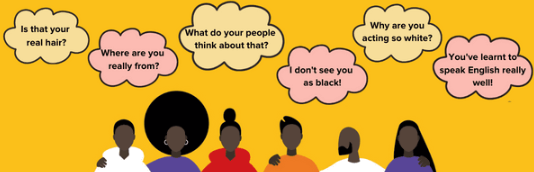
Types of microaggressions
Black people face microaggressions in a number of settings – in their places of learning, their places of employment, when they travel and where they shop. These microaggressions are mostly associated with stereotypes around them having less intelligence, being more likely to demonstrate violence or aggression, being a criminal and/or being lazy and therefore less hardworking than others.
These are covert or more nuanced types of interpersonal racism which are conscious or unconscious forms of brief but stunning forms of discrimination. They communicate hostile, derogatory or negative racial slights and insults toward people of underrepresented communities and/or people perceived to hold less power. They can take the form of microassaults, microinsults and microinvalidations.
These are covert or explicit racial disparagements/derogations which are characterised primarily by a violent verbal, nonverbal or environmental attack that is intended to harm the target person through name calling, avoidant behaviour or purposeful discriminatory actions. Examples of microassaults include:
- Calling a person “coloured” or the N-word
- Using racial epithets (e.g. “thugs”) to refer to black people
- Displaying a swastika
These are covert, verbal or nonverbal “subtle snubs” often out of a person’s consciousness although the underlying message is explicitly insulting to the target person. They include communications that convey rudeness and insensitivity and demean a person’s identity. They may take the form of a backhanded compliment. Examples of microinsults include saying to a black person:
- “How did YOU get your job?”
- “You’re very articulate”
- "You sound white”
- “You speak English well”
These microinsults are tied to assumptions of inferiority or being a foreigner.
These are communications that exclude, negate or nullify the psychological thoughts, feelings or experiential realities of people who experience microaggressions. Examples of microinvalidations include:
- Saying “I don’t see colour”
- Asking “Where are you really from?”
- Suggesting that “racism doesn’t exist today”
- Saying “you’re not black black”
These microinvalidations deny the experiential reality of the target person.
The mental health impact of microaggressions
Repeatedly experiencing racial microaggressions reinforces and perpetuates oppression, including marginalisation.
When people encounter racial microaggression or a racially stressful event, it creates a cognitive load which requires them to ask themselves what just occurred. According to Kevin Nadal, a racial microaggressions expert, they engage in a three-part decision-making model in which they ask themselves:
- Did this microaggression really occur?
- Should I respond to this microaggression?
- How should I respond to this microaggression?
If they choose NOT to confront the situation, this may result in:
- Feelings of regret
- Remorse
- Isolation
- Guilt and/or shame
Choosing to confront the situation may result in them experiencing:
- A fear that they are negatively representing their social/racial group
- A fear of retaliation from the person(s) confronted (e.g. a student may fear that a professor will change their grade)
- A fear that they will be ineffective in challenging the microaggression
How to address microaggressions
As racial microaggressions attack the black person’s sense of identity, we need to take steps to address this. There are a number of ways to do this including developing racial pride and exploring the way we have been racially socialised. Other ways we can deal with this is through microaffirmations, microresistance and self-care.
These are statements that acknowledge who a person is and emphasise their value. For example:
- “I am intelligent and I accept that now. I refuse to believe any other description of me”
- “I refuse to believe I am unlovable any longer. I am loved and I am loveable. I accept that now”
- “I refuse to believe that I am not good enough any longer. I deserve to be here and I accept that now”
These are actions that help people to cope with and respond to microaggressions. For example:
- Increasing their mental, emotional, relational and spiritual resources
- Challenging the microaggressions and the normalisation of whiteness when they experience it
- Being an ally to someone else when they have experienced a microaggression
- Identifying opportunities for growth, healing and empowerment
“Caring for myself is not self-indulgence, it is self-preservation, and that is an act of political warfare.” Audre Lorde
If left unacknowledged, repeated exposure to racial microaggressions may lead to a complex type of post-traumatic stress disorder called racial trauma. As racially traumatising experiences do not need to be experienced directly but can be experienced vicariously through social networks (a friend, family or community member), it’s important to take steps to avoid this happening. For example, you could:
- Limit your news and social media intake as this can be a source of trauma
- Recognise your physical, emotional, and mental limits
- Acknowledge your feelings – learn to name them and how they impact you
- Remember that feelings are temporary
- Check in with your thinking and remember your self-talk. “Sow a thought, reap an action; sow an action, reap a habit; sow a habit, reap a character; sow a character, reap a destiny.” Stephen Covey
- Seek out community spaces where you can get culturally relevant support
- If you have a faith, pray, meditate and seek support through religious text and your faith community. Take a look at Good Thinking’s tailored wellbeing resources for faith and belief communities
- Surround yourself with people who are supportive and safe
- Get active – trauma sits in the body so try to use movement to dispel some of the trauma your body might be holding
- Engage in self-care by taking part in activities that make you happy or give you joy
- Make a note of the situations where you tend to experience racial microaggressions and prepare/role play your response ahead of time
Useful Resources
- Black Minds Matter UK - charity organisation connecting black individuals and families with free mental health services
- Black River Counselling – culturally specific short-term counselling for black people by black counsellors and psychotherapists in Lambeth and Southwark
- Croydon BME Forum - provides mental health support to Croydon’s black and minority ethnic communities
- NHS Talking Therapies - free NHS psychological therapies to support people with common mental health problems like anxiety and depression
- The Empowerment Group (teg) - heavily subsidised online 1:1 culturally appropriate therapy for people of Black African and Caribbean heritage (please note that this is not a free service)
- The Black, African and Asian Therapy Network - the largest community of Counsellors and Psychotherapists of Black, African, Asian and Caribbean Heritage in the UK
References
- Pierce, C., & Carew, J. Pierce-Gonzalez, D., & Willis, D.(1978). An experiment in racism: TV commercials. Television and education, 44, 62-88.
- Sue, D. W., Capodilupo, C. M., Torino, G. C., Bucceri, J. M., Holder, A., Nadal, K. L., & Esquilin, M. (2007). Racial microaggressions in everyday life: implications for clinical practice. American psychologist, 62(4), 271.
- Nadal, K. L. (2011). The Racial and Ethnic Microaggressions Scale (REMS): construction, reliability, and validity. Journal of counseling psychology, 58(4), 470.
- Nadal, K. L., Griffin, K. E., Wong, Y., Hamit, S., & Rasmus, M. (2014). The impact of racial microaggressions on mental health: Counseling implications for clients of color. Journal of Counseling & Development, 92(1), 57-66.