

Internalised racism and oppression
 This blog explains how racism can affect feelings of inferiority, hopelessness and low self-esteem and is a considerable mental health risk for the black community.
Cheryl Taylor - LSBU Integrated Wellbeing Advisor and OfS Black Students Mental Health Project Officer
“When you control a man's thinking you do not have to worry about his actions. You do not have to tell him not to stand here or go yonder. He will find his 'proper place' and will stay in it. You do not need to send him to the back door. He will go without being told. In fact, if there is no back door, he will cut one for his special benefit. His education makes it necessary.”
Carter G. Woodson, The Mis-Education of the Negro
Racism is embedded in the fabric of British society and continues to be a considerable mental health risk factor for the black community. This is because racism is an organising structure of individual perceptions and personal experiences, which means that marginalised community members are constantly encountering racism on systemic, institutional and interpersonal levels. This can mean that, when racism is not named and properly processed, it may lead to the racist beliefs about marginalised communities, including the community a person belongs to, becoming internalised.
What is internalised racism?
When racism is internalised, the person accepts the negative attitudes, beliefs, stereotypes and ideologies that the dominant society perpetuates about the marginalised racial group. The power that the dominant group holds in society enables them to determine what is correct, acceptable or normal. Any deviation from this standard is therefore labelled as incorrect, unacceptable and/or abnormal.
In addition, internalised racist beliefs can become psychologically toxic and may evoke negative emotions which can lead to the onset of mental health conditions, such as depression. Internalised oppression is linked to feelings of inferiority, low self-esteem, self-doubt, helplessness and hopelessness. It is also implicated in the self-perpetuation of oppression and an anti-black bias.
Internalised oppression can emerge over time and may elicit denial and a sense of powerlessness. Some research suggests that internalised racism occurs through the shame and the humiliation that occurs when the self is repeatedly devalued. It should be noted that depression linked to racism could be suppressed rage. It might also be expressed through obesity, addictions, high blood pressure, stress or domestic violence.
Understanding stereotypes
Understanding stereotypes and the role they play in hampering thinking capacity is important when exploring racism. Stereotypes are thinking shortcuts that we all use to sort or organise objects in our social environment. These can be particularly helpful in pressurised environments as they reduce the amount of brain power we need to process the things we encounter and help us to respond with speed.
The problem with stereotypes is that they are generalisations and therefore do not take into consideration all of the available information. As such, they can often be linked to negative outcomes for the individuals or groups associated with them. There has been a considerable amount of research indicating that being conscious of a negative stereotype which relates to a specific aspect of your identity can lead to poor or underperformance.
As such, it is important to explore whether you have internalised negative stereotypes which result in internalised oppression and racism. You can begin to do this by asking yourself about how you have been racially socialised.
Racial socialisation is a process frequently initiated by black parents during their children’s childhood and adolescence. When parents are effective in racially socialising their children, they create a protective buffer against the negative racial messaging and experiences their children will encounter whilst living in marginalised environments. It is important to note that racial socialisation occurs whether parents approach it actively or not.
People who have internalised racism are likely to have had little or no active or positive racial socialisation and may have passively internalised negative messaging about their racial group. Others who have experienced proactive racial socialisation have consistently been associated with the development of racial pride and experience the psychological benefits of racial socialisation, such as resilience.
Use the illustration below to explore the ways you have been socialised and begin to question some of the assumptions you may make about your racial group.
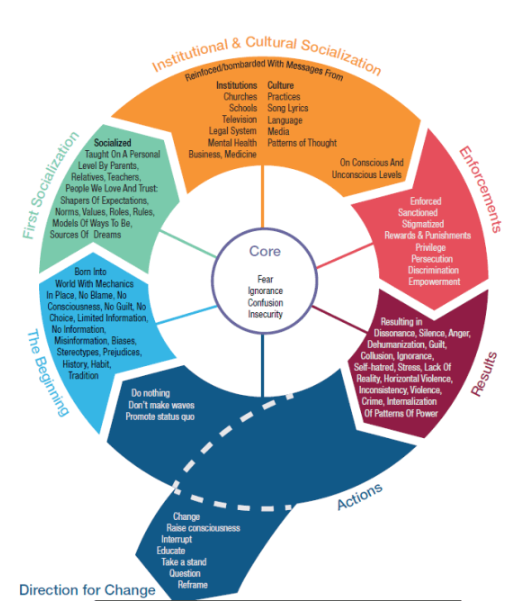
Harro's (1997) Cycle of Socialization
Think about a thought you have about your racial group that may have been implanted through your marginalised experience. You may find it useful to evaluate the thought using the questions below:
- What is the evidence for or against this thought?
- Are these thoughts based on my racial socialisation?
- Would others from my racial group agree with my perspective? Why or why not?
- Is it black and white or more complicated?
- Is the thought an exaggeration of the facts?
- Is the thought based on my or someone else's feelings or beliefs?
Being treated as racially inferior can feel painful so it is important to remember that this treatment is based upon the false belief of white superiority. Whilst this could be destructive to the way you define yourself, your family, your community and your culture, you can choose your strategies (e.g. exploring racial identity and promoting racial pride) and reject that inferiority.
There are a number of models which explore the development of racial identity. For example, William Cross developed the model of Nigrescence, which describes a process of becoming black. Cross believed that black people move through five developmental stages in the process of resocialisation. This process was deemed to help a black person develop from the stage where they have internalised racism and define themselves by the white majority groups terms to the stage where they are committed to the emancipation of themselves and their racial group.
Use the summary of Cross’ theory below to help you explore where you are on the journey to emancipation.
- Pre-encounter - identifies with white culture, rejects or denies membership in black culture.
- Encounter - rejects previous identification with white culture, seeks identification with black culture.
- Immersion - Emersion - completely identifies with black culture and denigrates white culture.
- Internalisation - internalises black culture, transcends racism.
- Internalisation - Commitment - internalises black culture, fights general cultural oppression.
Three more things you can do to help you on this journey
- Explore your ethnic/racial history.
- Create a timeline of racialised experiences that have shaped your racial identity and begin to process those experiences in light of the new insights you have gained.
- Access culturally appropriate counselling or an emancipation circle group to help you to process your experiences.
Useful Resources
- Black Minds Matter UK - charity organisation connecting black individuals and families with free mental health services
- Black River Counselling – culturally specific short-term counselling for black people by black counsellors and psychotherapists in Lambeth and Southwark
- The Empowerment Group (teg) - heavily subsidised online 1:1 culturally appropriate therapy for people of Black African and Caribbean heritage (please note that this is not a free service)
- The Black, African and Asian Therapy Network - the largest community of Counsellors and Psychotherapists of Black, African, Asian and Caribbean Heritage in the UK
- Croydon BME Forum - provides mental health support to Croydon’s black and minority ethnic communities
- NHS Talking Therapies - free NHS psychological therapies to support people with common mental health problems like anxiety and depression
References
- Brondolo, E., Rieppi, R., Kelly, K. P., & Gerin, W. (2003). Perceived racism and blood pressure: a review of the literature and conceptual and methodological critique. Annals of Behavioral Medicine, 25, 55-65.
- Bryant-Davis, T. (2007). Healing requires recognition: The case for race-based traumatic stress. The Counseling Psychologist, 35(1), 135-143.
- Bryant-Davis, T., & Ocampo, C. (2005). The Trauma of Racism: Implications for Counseling, Research, and Education. The Counseling Psychologist, 33(4), 574–578.
- Cross Jr, W. E. (1995). The psychology of nigrescence: Revising the Cross model.
- Friesem, E. (2019). Stereotyping, Teaching About. The International Encyclopedia of Media Literacy, 1-5.
- Harro, B. (2000). The cycle of socialization. Readings for diversity and social justice, 2, 45-51.
- Johnson, A. J. (2020). Examining associations between racism, internalized shame, and self-esteem among African Americans. Cogent Psychology, 7(1), 1757857.
- Jones, C. P. (2000). Levels of racism: a theoretic framework and a gardener's tale. American journal of public health, 90(8), 1212.
- Kahneman, D., (2017). Thinking, fast and slow.
- Molina, K. M., & James, D. (2016). Discrimination, internalized racism, and depression: A comparative study of African American and Afro-Caribbean adults in the US. Group Processes & Intergroup Relations, 19(4), 439-461.
- Mwendwa, D. T., Gholson, G., Sims, R. C., Levy, S. A., Ali, M., Harrell, C. J., ... & Campbell Jr, A. L. (2011). Coping with perceived racism: a significant factor in the development of obesity in African American women?. Journal of the National Medical Association, 103(7), 602-608.
- Neblett Jr, E. W., White, R. L., Ford, K. R., Philip, C. L., Nguyen, H. X., & Sellers, R. M. (2008). Patterns of racial socialization and psychological adjustment: Can parental communications about race reduce the impact of racial discrimination?. Journal of Research on Adolescence, 18(3), 477-515.
- Steele, C. M., & Aronson, J. (1995). Stereotype threat and the intellectual test performance of African Americans. Journal of personality and social psychology, 69(5), 797.
- Wang, M. T., & Huguley, J. P. (2012). Parental racial socialization as a moderator of the effects of racial discrimination on educational success among African American adolescents. Child development, 83(5), 1716-1731.
- Woodson, C. G. (1990). The mis-education of the Negro. Trenton. NJ: African.