
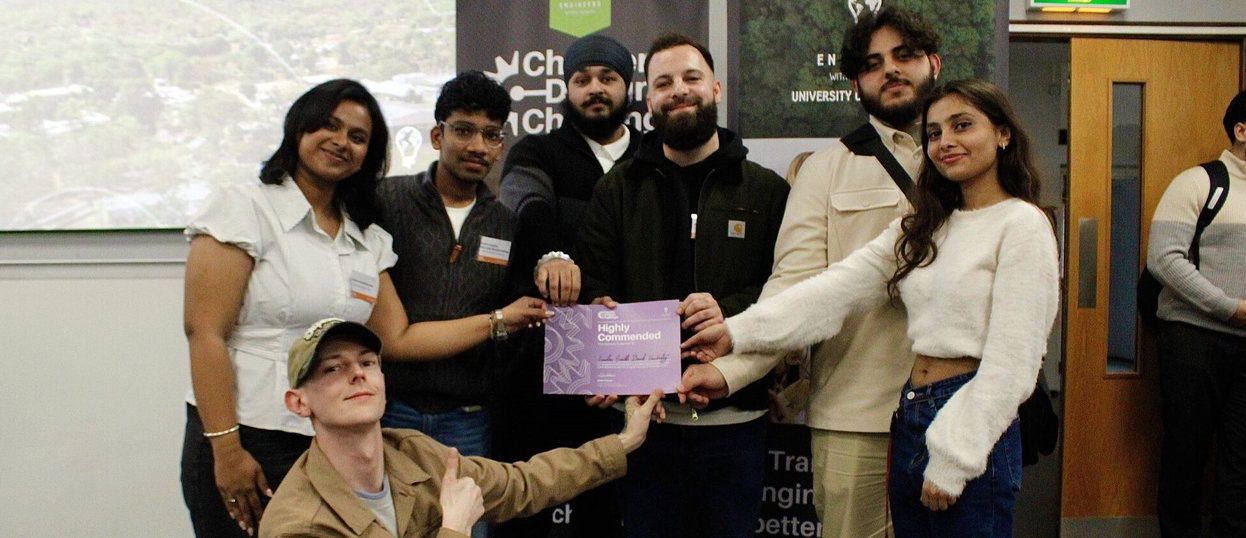
Students recognised at Engineers Without Borders Challenge Finals
A team of London South Bank University (LSBU) students have been awarded Highly Commended at the Engineers Without Borders UK Chapter Design Challenge 2026 Finals, after developing an innovative solution to a real-world engineering problem.
The Engineers Without Borders (EWB) Challenge is a student-led initiative, bringing together teams from across the UK to design practical solutions to challenges faced by communities around the world. This year, students were tasked with responding to infrastructure issues in Cape York, Australia — applying their skills to a live, global context.
Representing LSBU at the finals, held at the University of Birmingham, were students John-Paul Prentice, Charlie Webster, Trushi Patel, Harpreet Singh, Aaryani Santosh Marakwar, Riveen Ratnayake, Mohammed Elottol, Rafin Uddin and Goncalo Silva.
Their project, BRIDGE, is a simple offline diagnostic system designed to improve the reliability of borehole water infrastructure in remote communities. By helping users identify faults earlier and reduce unnecessary travel, the system supports more consistent access to water during periods of isolation.
The team’s work stood out among 21 university teams, earning them a Highly Commended recognition from industry judges.
For the students involved, the experience went beyond the final result — offering a chance to build confidence, collaborate and apply their learning in a meaningful way.
“Taking part in the Chapter Design Challenge was a really valuable experience for me” said Riveen Ratnayake, a first year Electrical and Electronic Engineering student. “It helped me build confidence in research, teamwork and public speaking, especially when presenting and pitching our ideas. It also showed me how engineering involves thinking about people, communities and the wider impact of what we design.”
Electronic and Computer Systems Engineering student Harpreet Singh added: “As a first-year student, this was a really rewarding and eye-opening experience. It gave me the chance to work in a more structured and professional team environment, while also improving my confidence in public speaking. It’s something that will stay with me throughout university and beyond.”
Through the challenge, the team gained early exposure to real-world engineering, developing solutions rooted in community needs, working collaboratively across disciplines, and understanding the broader impact of their designs.